
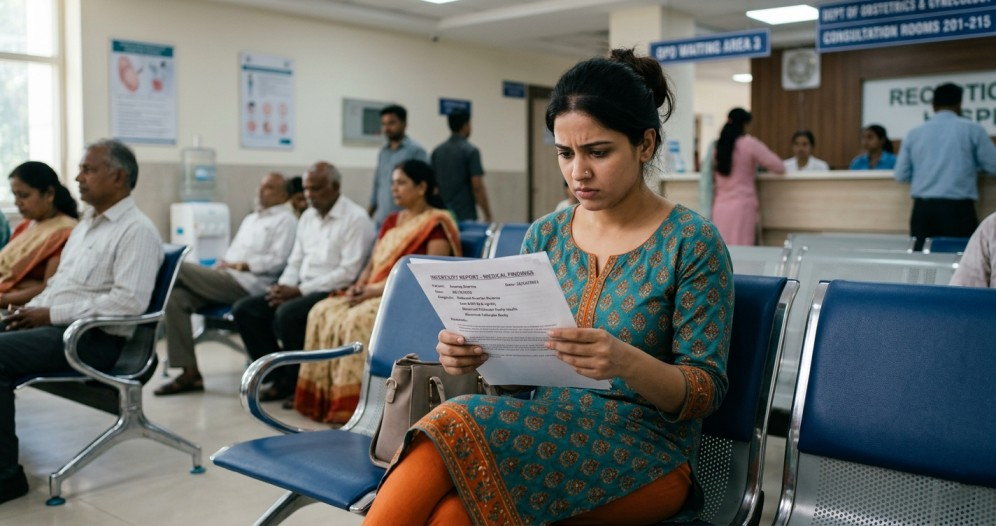
When a pregnancy test kit shows “negative”, that brings disappointment with self-doubt and silent blame.
Why does this happen again and again?
Is something wrong with me?
In my practice, I see many women who have these questions during their first visit. I tell them gently that you are not alone in this journey. Sometimes repeated negative tests may indicate some hidden fertility issues.
So, here, understanding of infertility has become important.
As per the WHO, infertility is the inability to get pregnant even after trying for 12 months. In India, approximately 15-20% couples face this challenge.
It can be due to either women’s or men’s fertility issues or both. The symptoms of infertility in women may range from hormonal issues to complex reproductive issues.
In this guide, we help you understand women’s infertility so you can move from confusion to clarity.
What Is Infertility in Women?
Infertility in women means you cannot achieve pregnancy even with regular attempts without using any birth control. We diagnosed infertility in women based on age and duration of trying:
| Age Group | When Is Infertility Diagnosed? |
| Under 35 years | Trying for 1 year without success |
| Over 35 years | Trying for 6 months without success |
There are two types of infertility. If pregnancy has never happened with trying, we call it primary infertility. If pregnancy happened once in the past but not again, it is called secondary infertility.
In India, studies show that about 4% to 17% women face infertility challenges. Primary infertility affects around 2–3%, while secondary infertility is more common, affecting 13–14%.
So, how do you know that your body gives you early signs? Let’s understand the signals you should not ignore.
Signs and Symptoms of Infertility in Women
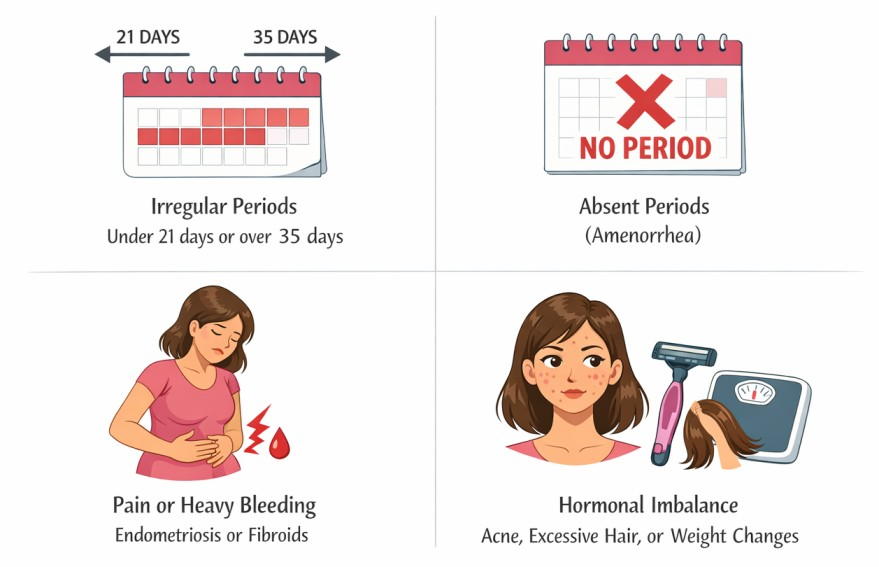
Common symptoms of infertility in women that we notice in clinical practice include:
- Your periods arrive irregularly, either under 21 days or over 35 days.
- Your periods stop completely (amenorrhea).
- You feel pain or heavy bleeding during periods may be signs of endometriosis or fibroids.
- Acne, excessive hair growth, or sudden weight changes indicate your hormones are imbalanced.
Why do these changes happen? To find out, we must look at the medical causes of infertility in women.
Main Causes of Infertility in Women
We see that the cause of infertility in women is linked to three factors: ovulation problems, fallopian tubes or uterus problems and cervical mucus issues, which is also supported by the American Pregnancy Association.
| Category | Common reasons | Simple explanation |
| Ovulation problems | Past infections, pelvic inflammatory disease, fibroids, polyps, endometriosis, a past ectopic (tubal) pregnancy, birth defects | Sometimes your ovary does not release an egg. This can be due to hormonal issues or lifestyle changes. |
| Fallopian Tube or Uterus Issues | Past infections, pelvic inflammatory disease, fibroids, polyps, endometriosis, a past ectopic (tubal) pregnancy, and birth defects | If your tubes are blocked, the egg and sperm can not meet. Sometimes growths in your uterus can stop the baby from attaching properly. |
| Cervical mucus problems | Abnormal cervical mucus | The cervix makes fluid that helps sperm travel. If the fluid is too thick or unhealthy, sperm may struggle to reach the egg |
One of the first things that we tell our patients is that infertility is not their fault. With proper diagnosis and modern treatments, we support you to move closer to your dream of parenthood.
Now that we have seen the main causes, let’s talk about a common concern many women have: regular periods but not getting pregnant.
Why Am I Not Getting Pregnant Even With Regular Periods?
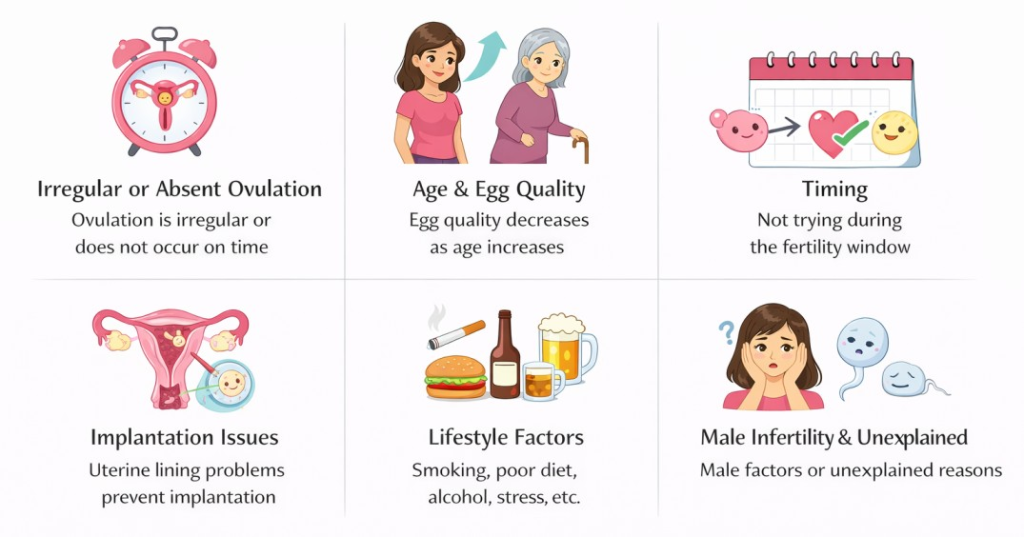
When patients come to us for a check-up, our first question is, “What is your last period date?” This helps us to understand your period and identify your fertile window. Here, the fertility window is the best time when the chances of pregnancy are high.
Even if your periods are regular, it does not always mean fertility is normal.
So, what could be the reason behind this?
- Your ovulation does not occur on time, either irregular or absent, even with a regular period.
- As your age increases, your egg quality decreases.
- If you are not trying during the fertility window.
- Sometimes the egg and sperm meet, but implantation does not occur due to uterine lining problems.
- Lifestyle factors like smoking, poor diet, alcohol, and stress can delay conception.
- In some cases, male infertility or unexplained reasons may also be responsible, so understanding both partners’ health becomes important.
How Is Female Infertility Diagnosed?
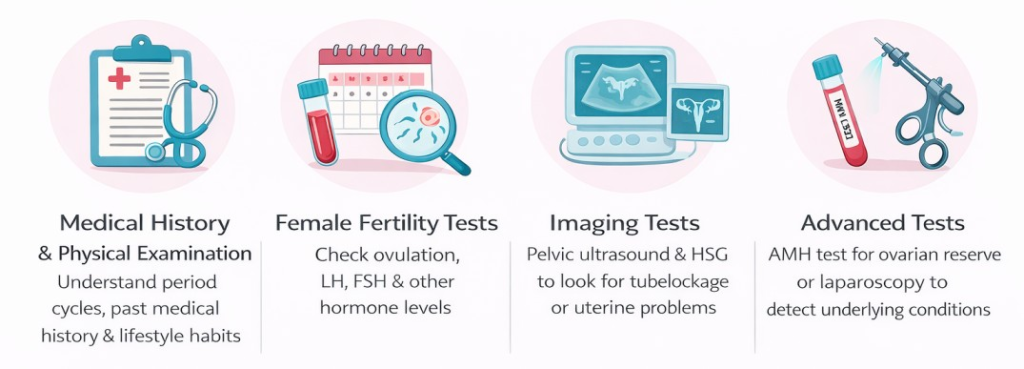
When you visit us with concerns about not getting pregnant, our first goal is to understand the underlying cause and guide you toward the right treatment. If you are visiting a fertility clinic for the first time, it helps to know what tests and discussions to expect during your consultation.
We follow a step-by-step procedure to evaluate your fertility:
- Medical History & Physical Examination: First, we understand your period cycle, past medical history and lifestyle habits.
- Female Fertility Test: We track your ovulation through follicular study. Also, we suggest a blood test to check your hormone levels, such as LH and FSH.
- Imaging Tests: We use a pelvic ultrasound and an HSG (X-ray hysterosalpingogram) test to look for tube blockage or uterine problems.
- Advanced Tests: We may suggest an AMH test to measure ovarian reserve (egg supply) or a laparoscopy evaluation to detect conditions such as endometriosis.
This helps us plan the most suitable treatment for you.
So, what are the treatment options? Let’s take a look.
Treatment Options for Female Infertility

When we talk about infertility treatment, there are various options we may suggest depending on each patient’s needs.
1. Medications:
Mostly, we start with simple medication that helps in the release of eggs from your ovaries.
2. Assisted Reproductive Technology (ART):
If needed, we may suggest advanced treatments like IUI or IVF.
- IUI: We place sperm directly into the female uterus.
- IVF: We take eggs from a female, in the lab we fertilize eggs and sperm, and after that we transfer the embryo into the uterus. To understand the process in detail, you can read about IVF treatment.
3. Lifestyle Improvements:
We also guide you on weight management, stress control, and fertility supplements, as these can improve overall reproductive health.
Together, these infertility treatment options give us a pathway to improve your chances of conception.
When Should You See a Doctor?
Many couples continue trying for months without success, and they are unsure of when to seek help.
We suggest consulting a doctor if:
- You are under 35 and tried for a year to get pregnant without success.
- You are over 35 and tried for six months without success.
- Your periods come irregularly, so ovulation is hard to predict.
- You know you have issues like PCOS or thyroid disorder, which can directly affect ovulation and fertility.
- You face repeated pregnancy loss, even after conceiving.
Supporting Women on Their Path to Motherhood

At Kalyan Women’s Hospital and IVF Center, in Palanpur, Dr Rahul Patel provides advanced diagnosis and personalized treatment plans. With modern technology and high success rates, we are committed to supporting every couple on their journey to parenthood.
Final Thoughts
Infertility is treatable, and many couples successfully achieve pregnancy with the right care. Early diagnosis and timely treatment can improve outcomes. If you are facing difficulty conceiving, seeking expert guidance can be the first step toward a healthy and hopeful pregnancy journey.
FAQs
Doctors diagnose infertility after 6–12 months of trying without success using tests like blood work, ultrasound, and HSG. Treatment depends on the cause and may include medication, surgery, or IVF.
Common tests include hormone blood tests (FSH, AMH), pelvic ultrasound, ovulation tracking, and HSG to check fallopian tubes. These help identify the exact cause of infertility.
In many cases, infertility can be treated depending on the cause. Treatments like medications, lifestyle changes, IUI, and IVF have helped many women successfully conceive.
Fertility is highest in the late teens to late 20s. After age 30, it gradually declines, with a more noticeable decrease after 35.
IVF success rates are highest under age 35, especially in the late 20s to early 30s. Success gradually declines with age due to reduced egg quality.

3 Responses