
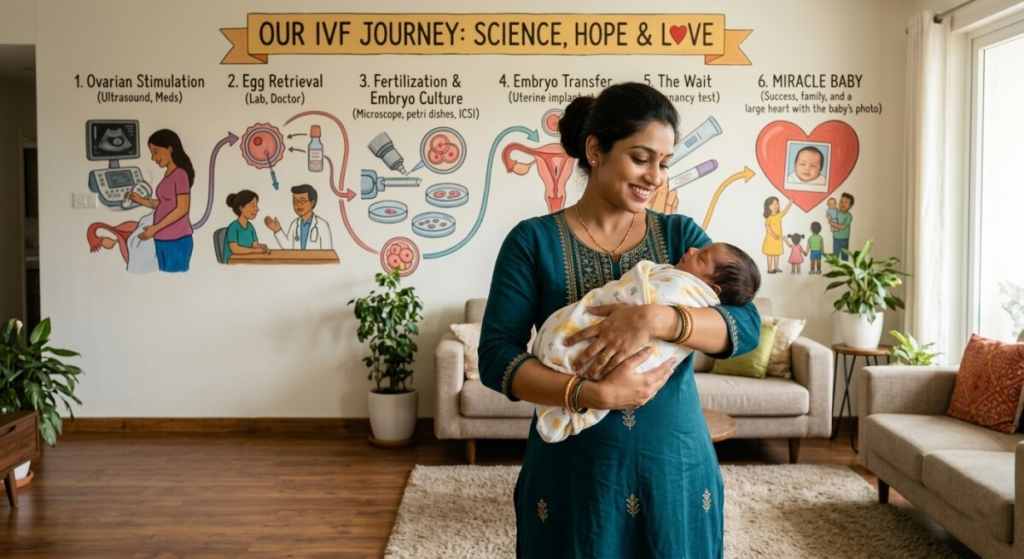
Did you know that around 27 million couples in India face infertility?
Why do millions of couples quietly suffer from infertility? What is infertility, really? Let’s see how the WHO define it.
WHO defines infertility as when any couple does not achieve pregnancy after trying for 12 months or more.
A government report shared by India Today says that about 8% of infertile couples in India may need advanced treatments like IVF to have a baby.
Choosing the right fertility care is important. This guide explains IVF treatment in Palanpur with easy steps, cost, success rates, and the care you receive. Help you feel clear, supported, and hopeful on your journey.
What is IVF Treatment?

IVF or In Vitro Fertilization is also called “test tube baby”. Here, “In vitro” means “outside”, so fertilization is occur in outside the body.
After collecting eggs and sperm from the body, combined in a laboratory to achieve fertilization. The embryo is transferred into the female uterus to grow naturally.
What is IVF treatment used for? IVF is mainly used to treat both female and male infertility. Blocked tubes, ovulation problems, or any hormonal conditions like PCOS (Polycystic Ovary Syndrome) can affect fertility and sometimes require IVF treatment.
Experts from AIIMS in New Delhi state that male infertility is due to lifestyle and stress. In cases where sperm quality is severely affected, advanced procedures like ICSI (Intracytoplasmic Sperm Injection) may be recommended to help fertilization occur.
First Step of IVF Treatment: What Happens Before You Start
Many couples are unaware of what the first step of IVF treatment is. The first step of IVF treatment is an overall infertility diagnosis.
For this, we advised the following test for both partners:
- Hormone testing: Mainly the AMH test to check ovarian reserve (Egg supply)
- Ultrasound monitoring: To visualise the ovaries and uterus
- Semen analysis: To check sperm health
After all diagnoses, we conduct fertility counselling for couples. To ensure they prepare emotionally and discuss other options. We also plan personalized treatment for each couple’s needs. This careful preparation ensures the best chance of success before starting the actual IVF procedure.
For some couples, doctors may first recommend simpler fertility treatments like IUI (Intrauterine Insemination) before moving to IVF.
IVF Treatment Procedure in Palanpur Step-by-Step
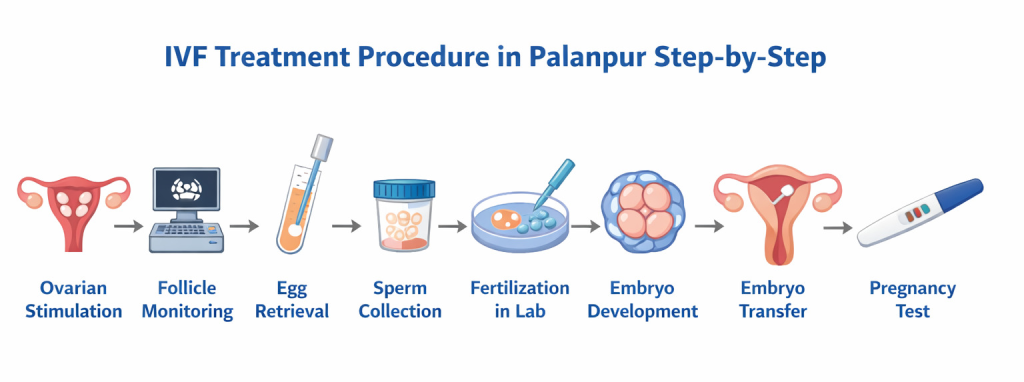
In Palanpur IVF treatment procedure is done with proper planning to maximize the chances of pregnancy by IVF speacilist.
IVF procedure step-by-step:
Step 1: Ovarian Stimulation (Growing eggs):
Your ovary usually produces one egg per month. In IVF, we want more eggs to increase the chances of pregnancy. For about 8 to 12 days of your period, we give a medicine (small injection) that produce few more eggs.
Step 2: Follicle monitoring (Checking the process):
Every few days, we do an ultrasound to check follicles (where eggs live). To make sure how the eggs are growing.
Step 3: Egg retrieval procedure (collecting the eggs):
Once the egg reach at mature stage, we collect it with a small needle. It is a few minutes procedures performed under sedation.
Step 4: Sperm collection:
During egg retrieval, your partner also provides a semen sample.
Step 5: Fertilization in the laboratory (Joining the egg and sperm):
In the lab, we bring your eggs and your partner’s sperm together to create embryos.
Step 6: Embryo development (Watching growth):
After we watch embryo growth in the next few days.
Step 7: Embryo transfer (Placing the embryo):
We place a healthy embryo into your uterus to begin the pregnancy process.
Step 9: Pregnancy test after IVF:
Around two weeks later, we will check with a pregnancy test to see if your IVF journey has been successful.
How Long Does IVF Take from First Appointment?
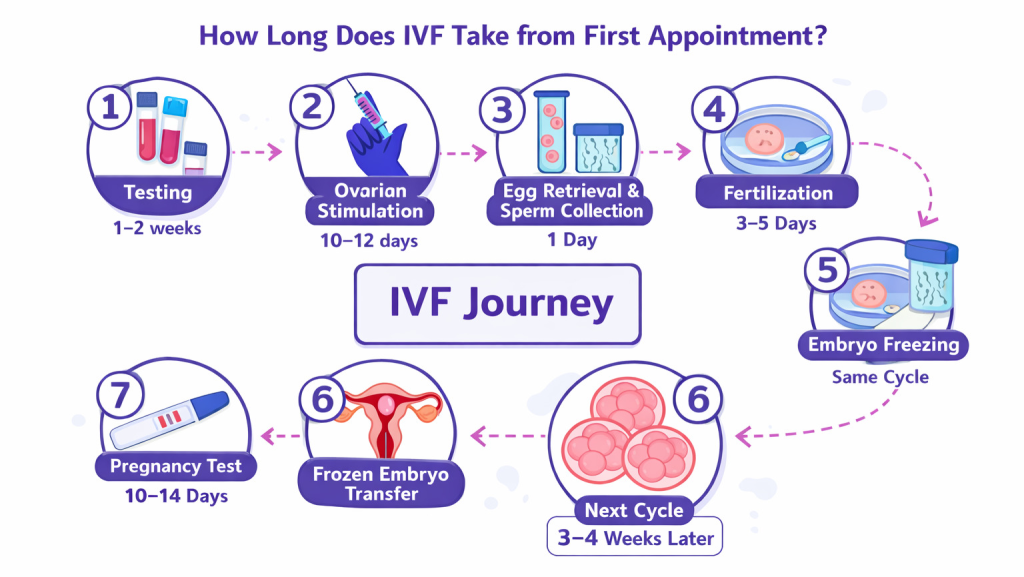
Here is how long each step of IVF usually takes, from your first appointment to the pregnancy test.
| Step | What Happens | Typical Duration |
| Testing phase | Basic health checks, blood tests, scans, and semen analysis | 1–2 weeks |
| Ovarian stimulation | Medicines help the ovaries make more eggs | 10–12 days |
| Egg retrieval & sperm collection | Eggs collected, sperm sample provided | 1 day |
| Fertilization & embryo growth | Eggs and sperm joined in the lab | 3–5 days |
| Embryo freezing (Egg Freezing) | Healthy embryos are frozen and stored for transfer later | Same cycle |
| Frozen embryo transfer (FET) | In the next menstrual cycle, the embryo is transferred to the uterus | Next cycle, about 3–4 weeks later |
| Pregnancy test | Blood test to confirm success | Around 10–14 days after embryo transfer |
At Kalyan Women’s Hospital & IVF Center palanpur, embryos are frozen and transferred in the next cycle. This helps the body to recover from stimulation medicines and helps prepare the uterus in a more natural environment, which improves implantation chances.
Because embryos are frozen and transferred later, the entire IVF journey usually takes about 6 to 8 weeks from the first appointment to the pregnancy test. Couples in Palanpur and nearby areas pick local IVF centers for easy access, customized care, and throughout help during the journey.
IVF Treatment Cost in Palanpur
IVF treatment in Palanpur costs around ₹90,000 to ₹2,00,000. It covers consultation, medications, egg pickup, lab work, and embryo transfer. Some couples in Gujarat pay ₹3 to 6 lakh, depending on added treatments. Affordable IVF options are available, but prices vary with age, cycle count, and other factors. Overall, the average IVF cycle in Palanpur is budget‑friendly compared to larger cities. Some clinics offer discounts and supportive care.
IVF Success Rates by Age in Palanpur
IVF success rates by age in Palanpur depend on egg quality, embryo health, lifestyle, and general health. Younger women see better results. Rates drop as age rises.
Here is a simple look at the average success rates in IVF.
| Age Group | Average Success Rate | Key Factors |
| Under 35 | 60–70% | Eggs are usually healthier, and sperm are strong |
| 35–40 | 50–60% | Egg numbers decline, and sperm quality may be reduced |
| Above 40 | 10–15% | Eggs are fewer and weaker; sperm health matters more |
These are average numbers, not guarantees. Your lifestyle, overall health, and the care you receive can make a big difference. With the right support, many couples improve their chances.
Choosing the Right IVF Specialist in Palanpur
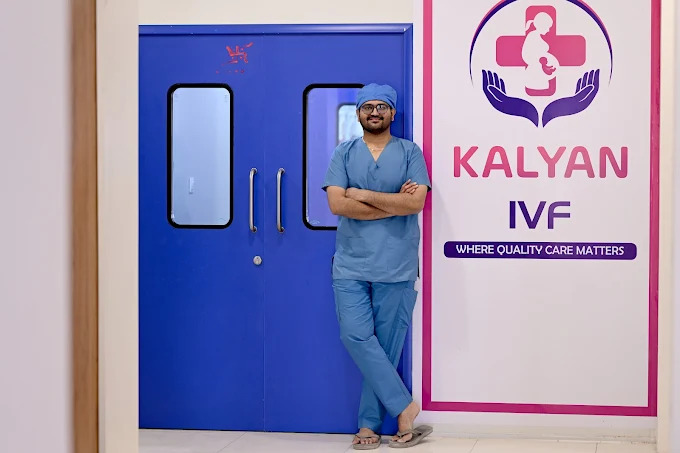
We know you want the best care. An experienced IVF specialist doctor makes a big difference. At our IVF centre in Palanpur, you get advanced fertility treatment with modern labs. We give you personalized care and transparent pricing. With good success rates, we support you every step. Patients from Palanpur and nearby towns trust us. Meet IVF specialist Dr Rahul Patel in Palanpur at Kalyan Women’s Hospital & IVF Center for compassionate guidance.
IVF Care & Lifestyle Tips for Better Outcomes
We want you to feel supported during IVF. Your lifestyle choices can make a big difference in success.
- Eat a balanced diet and manage your weight.
- Reduce stress by doing relaxation and support.
- Get proper sleep every night.
- Avoid smoking and alcohol for your better health.
- Follow IVF medications exactly as the doctor prescribed.
Couples who are planning fertility treatment often benefit from understanding what happens during the first fertility clinic visit and the questions doctors may ask before starting treatment.
Together Toward IVF Success
IVF offers real hope for couples facing infertility. When you seek early consultation, you give yourself more options. With the right guidance, your chances of IVF success improve. IVF is not just a treatment; it’s a journey of hope, support, and new beginnings.
FAQs
The best age for IVF treatment is usually under 35 years, when egg quality and quantity are generally better. However, IVF can still help women in their late 30s and early 40s achieve pregnancy with proper medical guidance.
The number of IVF cycles needed varies for each couple. Some couples conceive in the first cycle, while others may require two or three cycles. Doctors often recommend planning for up to three IVF attempts depending on individual fertility factors.
Yes, IVF can work on the first attempt, but success varies for each couple. On average, the first-cycle success rate ranges from 30% to 40%, depending on age, fertility health, and embryo quality.
IVF is generally considered a safe and widely used fertility treatment. Most IVF pregnancies result in healthy babies. However, as with any medical procedure, doctors monitor patients carefully to manage any potential risks.
Most IVF procedures are not very painful. Hormone injections may cause mild discomfort, and egg retrieval is usually done under sedation, so patients do not feel pain during the procedure. Some women may experience temporary bloating or mild cramps during treatment.
IVF can be costly because it involves advanced laboratory technology, specialized fertility medications, medical monitoring, and skilled fertility specialists. Additional procedures such as embryo freezing, ICSI, or genetic testing can also increase the overall cost.