

For couples in Abu Road and Mount Abu who’ve been trying to conceive without success, the real question usually isn’t “what is IVF” — it’s “have we actually reached the point where we need it.” That’s worth pausing on, because not every fertility problem calls for the same treatment path.
Infertility in India is more common than most families realise. Data from the Indian Society of Assisted Reproduction shows infertility affects about 10 to 14 percent of the Indian population, with the rate rising to roughly one in six couples in urban areas.
A proper fertility evaluation — not a rushed decision — is what actually tells you whether medication, IUI, IVF, or something else fits your situation. For families from Abu Road’s rail-and-industry belt or the slopes of Mount Abu, that evaluation is a short trip away in Palanpur.
When Should You Consider IVF Treatment?
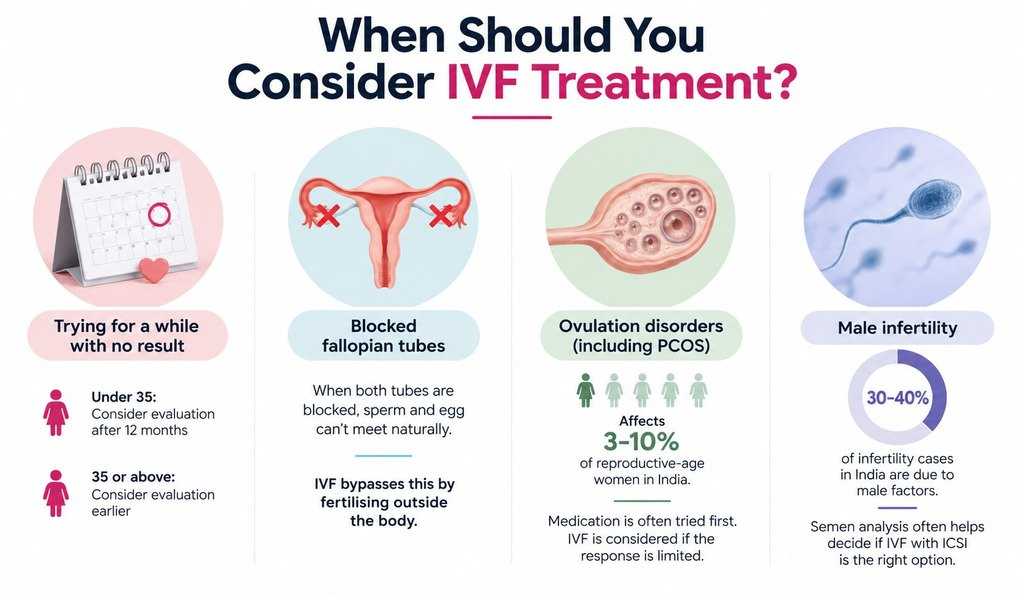
Not every couple facing a delay in pregnancy needs IVF as the first step. Medication, lifestyle changes, or IUI are enough for many. IVF becomes worth discussing when a specific, identifiable factor is involved — and these are the ones that come up most often:
- Trying for a while with no result. Under 35, most specialists suggest a fertility evaluation after 12 months of regular attempts; at 35 or above, that window generally shortens to 6 months.
- Under 35, most specialists suggest a fertility evaluation after 12 months of regular attempts; at 35 or above, that window generally shortens to 6 months.
- Blocked fallopian tubes. When both tubes are blocked, sperm and egg can’t meet on their own — IVF sidesteps this entirely by fertilising outside the body.
- Ovulation disorders, including PCOS. PCOS and related hormonal imbalances are estimated to affect roughly 3 to 10 percent of Indian women of reproductive age, making it one of the most common ovulation-related causes seen in clinic. Ovulation induction or medication is often tried first; IVF comes in when that response is limited.
- Male infertility. This isn’t a side issue — a 2015 industry-wide estimate put the male factor at 30 to 40 percent of infertility cases in India, close behind the female factor at 40 to 50 percent. In male infertility, semen analysis findings often decide whether IVF with ICSI is the more direct route.
A fertility evaluation can also help identify causes of infertility in women before a treatment such as IUI or IVF is considered.
What Does an IVF Cycle Actually Involve?
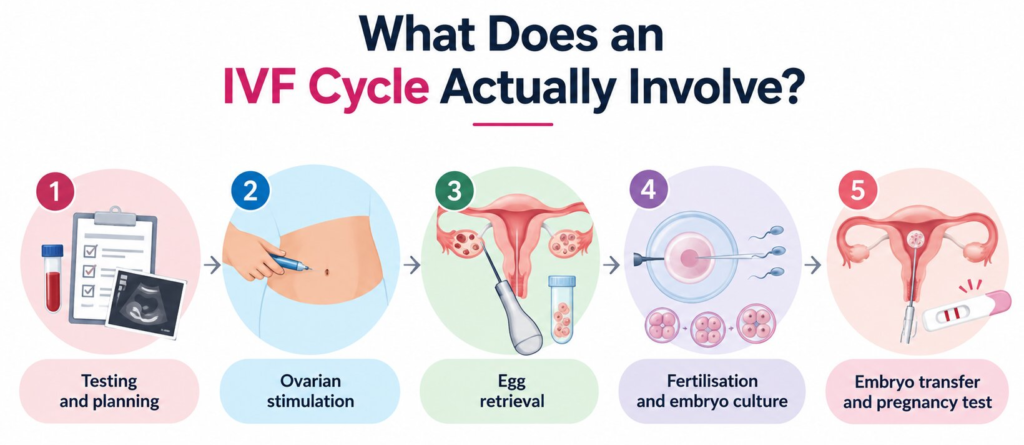
An IVF cycle isn’t one procedure — it’s a short sequence spread across roughly one menstrual cycle, typically 4 to 6 weeks start to finish. Here’s the shape of it:
- Testing and planning — hormonal blood work, ultrasound, AMH levels, and a semen analysis establish the starting point for both partners.
- Ovarian stimulation — fertility medication encourages multiple eggs to develop, tracked through ultrasound scans every 2–3 days.
- Egg retrieval — once follicles reach the right stage, eggs are collected in a short outpatient procedure.
- Fertilisation and embryo culture — eggs and sperm are combined in the lab (with ICSI used where male-factor infertility is significant), and embryos are monitored over the following days.
- Embryo transfer — a suitable embryo is placed in the uterus, followed by a pregnancy test roughly two weeks later.
The stimulation phase is the part that needs the most frequent monitoring visits — worth keeping in mind if you’re planning this around travel from Abu Road or Mount Abu.
IVF vs IUI: What’s the Real Difference?
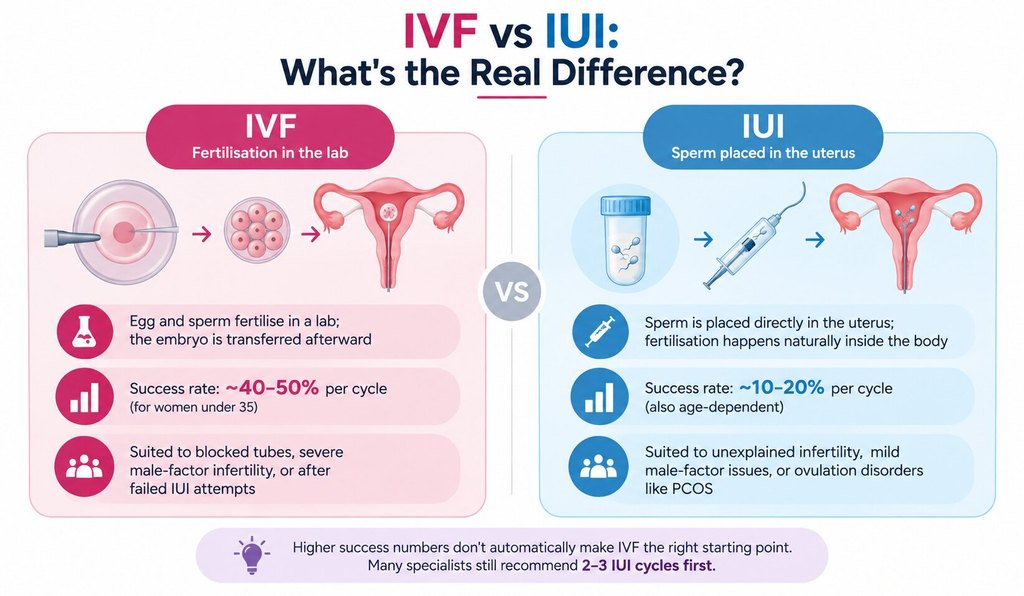
Both treatments show up in the same conversation, but they work on different principles. For unexplained infertility, treatment decisions depend on the diagnostic work-up and the individual circumstances rather than a single treatment pathway.
| IVF | IUI |
|---|---|
| Egg and sperm fertilise in a lab; the embryo is transferred afterwards | Sperm is placed directly in the uterus; fertilisation happens naturally inside the body |
| Success rates run roughly 40–50% per cycle for women under 35, tapering with age | Success rates run roughly 10–20% per cycle, also age-dependent |
| Suited to blocked tubes, severe male-factor infertility, or after failed IUI attempts | Suited to unexplained infertility, mild male-factor issues, or ovulation disorders like PCOS |
Higher success numbers don’t automatically make IVF the right starting point. Many specialists still recommend 2–3 IUI cycles first when the diagnosis allows it, moving to IVF only if that doesn’t work — age and diagnosis decide the sequence, not the percentage on a page.
What Actually Moves the Success Rate?
There’s no single percentage that applies to every patient — but the factors behind that number split into two groups.
What age already sets in motion: the proportion of chromosomally normal eggs drops from roughly 35% abnormal at age 35 to closer to 60% by 40. That shows up directly in outcomes — live-birth rates per embryo transfer run around 48% for women under 35, drop to roughly 38% between 35–37, and fall further to under 20% past 40.
What your specialist can still influence: the stimulation protocol chosen, lab conditions during embryo culture, uterine health going into transfer, and how thoroughly the underlying cause of infertility was diagnosed before treatment started.
Age isn’t something a clinic can change. But a poorly matched protocol or a missed diagnosis can cost a couple a cycle that age alone wouldn’t have.
What Does IVF Cost Actually Depend On?
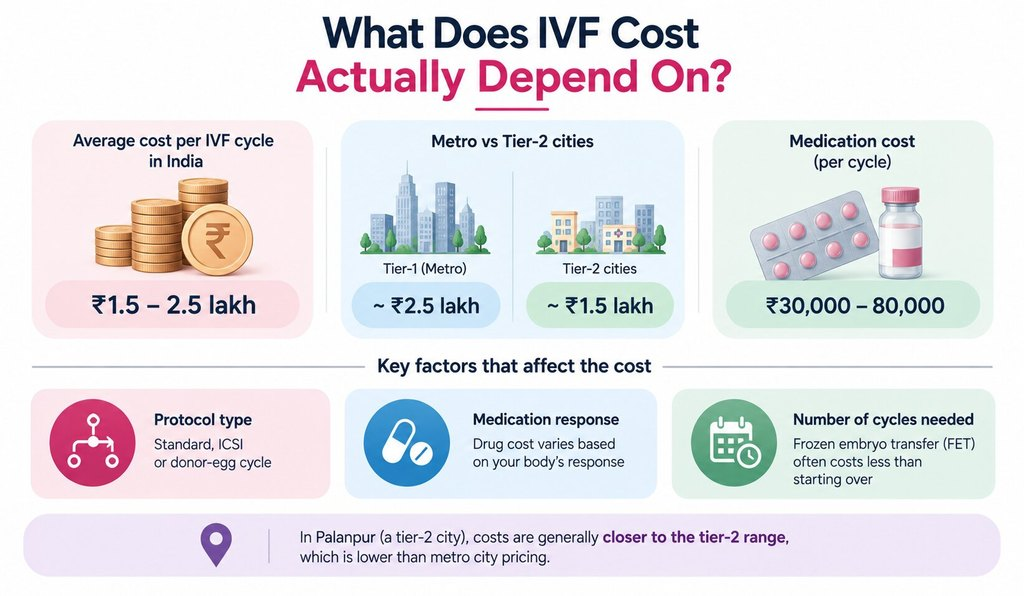
IVF pricing in India isn’t one number — it moves with both the treatment path and the city. Nationally, a single IVF cycle typically falls between ₹1.5 lakh and ₹2.5 lakh, but tier-1 metro clinics average closer to ₹2.5 lakh while tier-2 city clinics average nearer ₹1.5 lakh for a comparable protocol — a meaningful gap for a treatment that sometimes takes more than one cycle.
What moves the number for an individual patient:
- Protocol type — a standard cycle vs. ICSI (needed for male-factor cases) vs. donor-egg cycles carry different price points
- Medication response — stimulation drugs alone can range from ₹30,000 to ₹80,000 depending on how a patient’s body responds
- Number of cycles needed — a frozen embryo transfer (FET) after a failed fresh cycle costs a fraction of starting over
Because Palanpur isn’t a metro-tier clinic market, couples from Abu Road or Mount Abu are generally looking at costs closer to the tier-2 range above rather than metro pricing — worth factoring in before comparing quotes from bigger cities.
Planning Your Visits to Palanpur
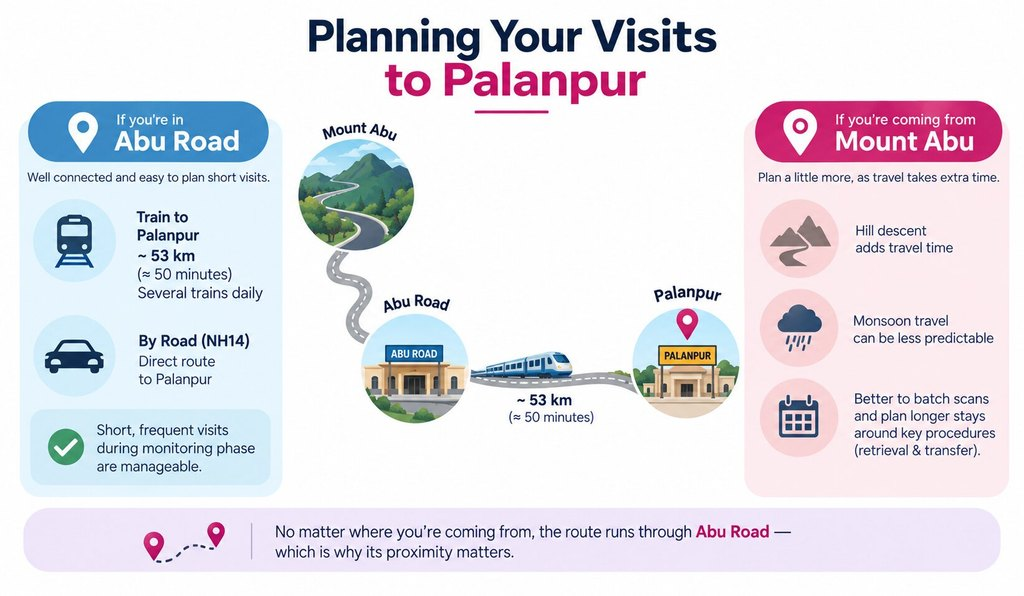
IVF isn’t a single appointment — the stimulation phase alone needs monitoring visits every 2–3 days for roughly two weeks. How that fits into your schedule depends on which of the two towns you’re starting from.
If you’re in Abu Road: you’re in a good position for this. Abu Road sits directly on the Delhi–Ahmedabad railway line, and Palanpur is roughly 53 km away — about a 50-minute train ride, with several trains running daily. NH14 gives you a direct road option as well. For an industrial town where many households already commute for work, fitting in short, frequent visits during the monitoring phase is manageable without major disruption.
If you’re coming from Mount Abu: the hill descent adds time before you even reach Abu Road’s rail or road links, and monsoon-season travel on the ghat road can be less predictable. Rather than planning frequent short trips, it’s usually more practical to consolidate: batch monitoring scans where possible, and plan for slightly longer stays around retrieval and transfer instead of multiple day trips up and down the hill.
Either way, the route runs through Abu Road — which is part of why proximity to it matters regardless of which town you call home.
Getting Your First Consultation
Before committing to any treatment path, the first step is a proper fertility evaluation — hormonal tests, ultrasound, and a semen analysis for both partners. This is what actually determines whether IUI, IVF, or another approach fits your situation, rather than starting IVF treatment in Palnpur based on assumptions.
For couples in Abu Road, this is a same-day trip using the rail or NH14 road link. For those coming from Mount Abu, it’s worth planning the first visit as a slightly longer day to also cover any follow-up scans on the spot.
Take the First Step

Whether you’re weighing this from Abu Road’s rail corridor or planning the trip down from Mount Abu, the decision to pursue IVF starts with the same step: a proper evaluation, not a guess. Age, diagnosis, and prior treatment history all shape which path — IUI, IVF, or something else — actually fits your situation.
Dr Rahul Patel and the team at Kalyan Women’s Hospital work with patients from across this region regularly, and can walk you through what a realistic plan and timeline would look like for your specific case.
FAQs
Expect roughly 5–7 visits across a cycle — an initial consultation, monitoring scans every 2–3 days during stimulation (about 2 weeks), retrieval, and transfer roughly two weeks later.
The same monitoring schedule applies, but most patients from Mount Abu consolidate visits where the specialist allows it, rather than making the hill descent every 2–3 days. Discuss this directly during your first consultation so the schedule is planned around your travel, not the other way round.
That depends on your diagnosis, not preference — tubal blockage or significant male-factor infertility usually points to IVF directly; unexplained infertility or mild ovulation issues often start with IUI.
Generally yes — tier-2 city pricing tends to run lower than tier-1 metro clinics for a comparable protocol, though the exact cost still depends on your specific treatment plan.