You have been trying to conceive for months. Every month brings new hope and excitement, but it turns to disappointment when your period arrives. And then your doctor says you have PCOS (now called PMOS).
At that moment, you have many questions, such as;
“Can I get pregnant with PMOS?”
“Is there still hope?”
“Will I need IVF?”
You are not alone in facing these challenges, but in our clinic we see many women with these concerns.
We reassure our patients that PCOS does not mean the end of your parenthood journey. It is a common hormonal and metabolic disorder that can make conception more challenging, but with the right treatment, many women go on to have healthy pregnancies.
So, let’s explore the connection between PCOS and infertility, its treatment options, and when you may need IVF.
What Is PCOS or PMOS?
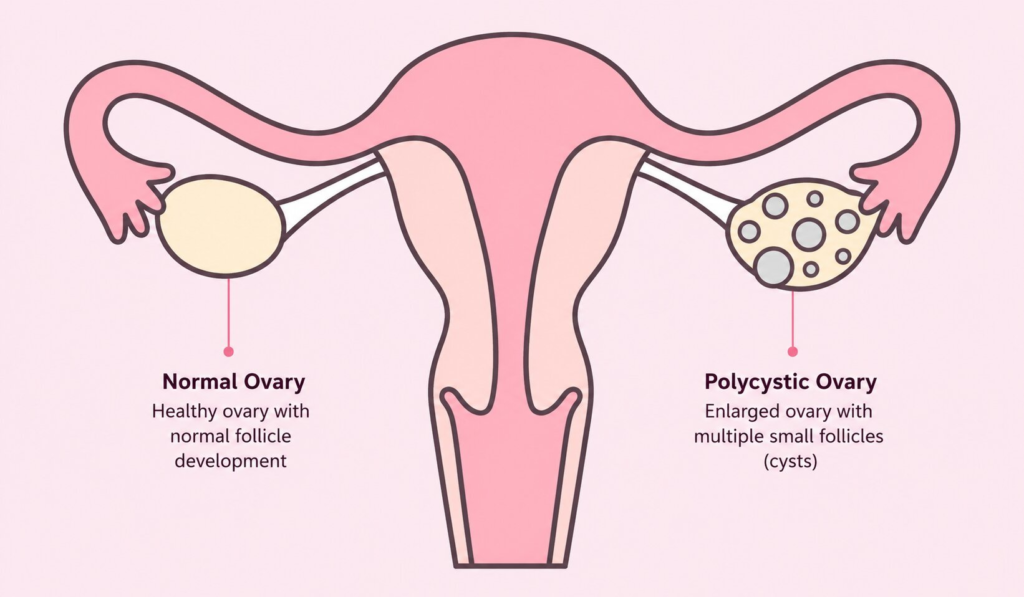
PCOS, or Polycystic Ovary Syndrome, which is the most common hormonal condition affecting women of reproductive age.
1 out of 8 women suffers from PCOS worldwide. In India, according to a study published in JAMA Network, it is almost 1 in 5 women. +
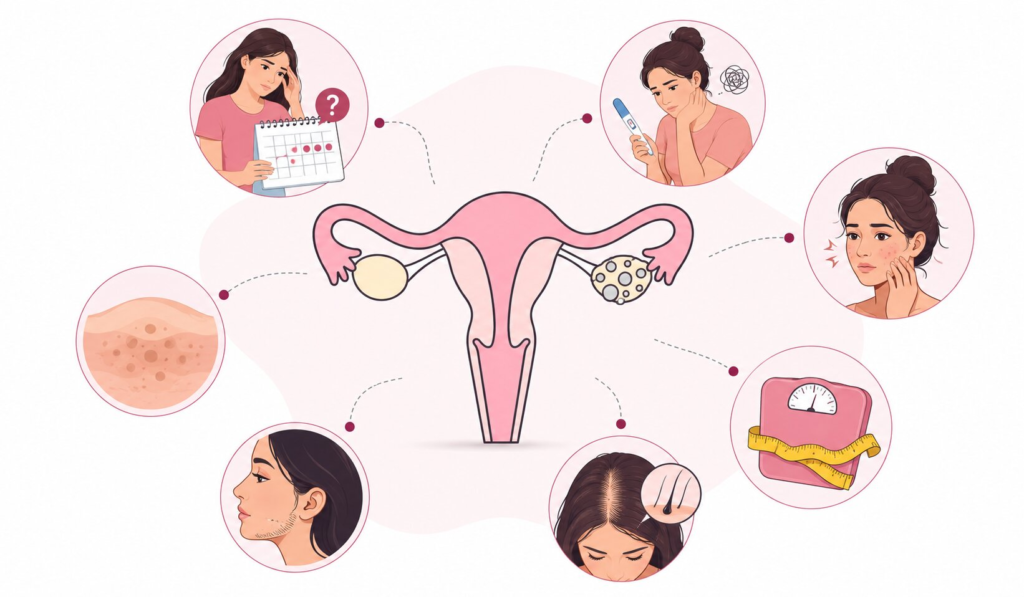
If you have PCOS, you may experience:
- Irregularities in the menstrual cycle
- Inability to have a child
- Presence of acne
- Excess facial or body hair
- Overweight
- Thin hair
- Skin pigmentation
- Numerous small cysts on your ovaries detected with ultrasound
PCOS Has a New Name: PMOS
As fertility specialists, one question we hear quite often is, “Why has PCOS been renamed PMOS?”
The reason is simple: the previous name did not fully describe the condition.
As the PCOS name suggests, there is the term “ovarian cyst”, but many women with PCOS do not actually have ovarian cysts. To more accurately describe this phenomenon, the international panel of specialists suggested a new term: Polyendocrine Metabolic Ovarian Syndrome (PMOS).
In fact, about 25–45% of women with PCOS also have metabolic syndrome, highlighting that the condition affects more than just the ovaries. Means it affects your hormones, metabolism, ovulation, and overall reproductive system.
As the new name is introduced gradually, you may hear both PCOS and PMOS interchangeably.
How Does PMOS Cause Infertility?
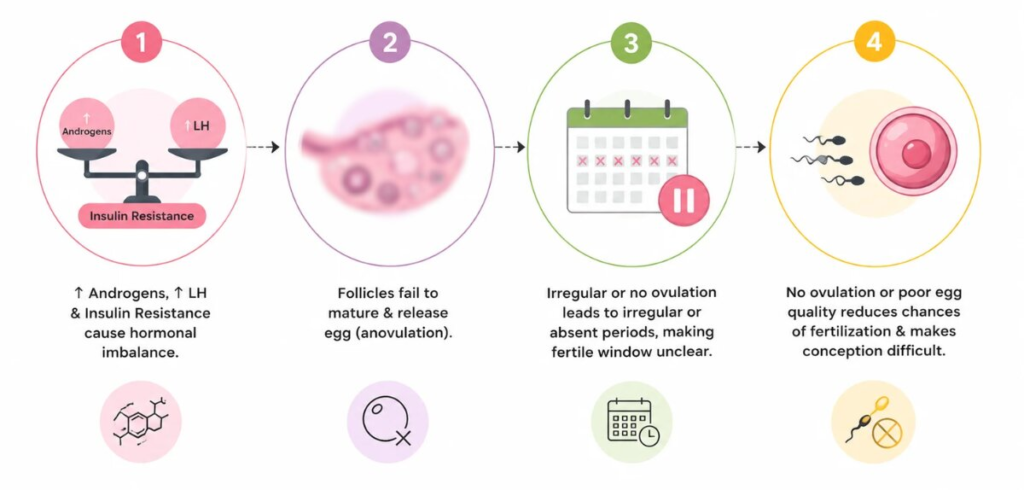
Think of pregnancy as a series of steps. For successful conception, all steps need to take place in the proper sequence. Understanding the common causes of infertility in women can also help explain why pregnancy sometimes takes longer than expected, even when PMOS is only one of several contributing factors.
Here is how PMOS affects this process:
- In PMOS, you have increased androgens (male hormones) and LH hormone, and also insulin resistance. These factors lead to hormonal imbalance.
- Due to hormonal imbalance, your ovarian follicles are unable to grow and release a mature egg. This condition is known as anovulation.
- Irregular ovulation or anovulation results in you facing irregular periods or even the absence of periods, which makes it impossible for you to identify the proper fertile window.
- The lack of ovulation or poor egg quality leads to difficulties in conception because of a lower possibility of fertilization.
Can You Get Pregnant with PCOS/PMOS?
Yes, you can. Having PMOS does not mean you can not get pregnant. But yes, PMOS simply means your body takes a little extra time to release an egg.
Think of your monthly cycle like a simple traffic light. With PMOS, the light gets stuck on yellow for a long time, slowing down your body’s egg release. We simply recommend easy daily habit changes or mild-dose medication to turn this yellow light to green so your egg comes out right on time.
Many of our patients can get pregnant naturally with these approaches. But if these approaches are not successful, we may recommend other treatments based on medical evaluation and identification of the root causes.
First-Line Treatment: Ovulation Induction
If your periods are irregular, our goal is simply helping your ovaries release a healthy egg on time.
For this, we give you letrozole, a first-line medication used for ovulation induction in PMOS. It is safe and effective and works by lowering estrogen levels temporary basics, so your pituitary gland releases more FSH (follicle-stimulating hormone) to stimulate follicles.
Your treatment usually follows these simple steps:
- We prescribe letrozole for 5 days from your period day 2 or 3
- We monitor how your follicles grow from day 10 to 11 until they rupture
- When we notice follicles are ready for rupture from that day, we advise the best time to try for pregnancy or IUI
- In some cases, an hCG trigger injection is required to help your follicles release the egg
A study published in the New England Journal of Medicine showed that Letrozole achieved a 61.7% ovulation rate and a 27.5% live birth rate in women with PCOS, making it the preferred first-line treatment for ovulation induction.
For couples considering assisted reproduction after ovulation induction, understanding the difference between IVF and IUI can help in making informed treatment decisions.
How IVF Improves Chances of Pregnancy for PMOS
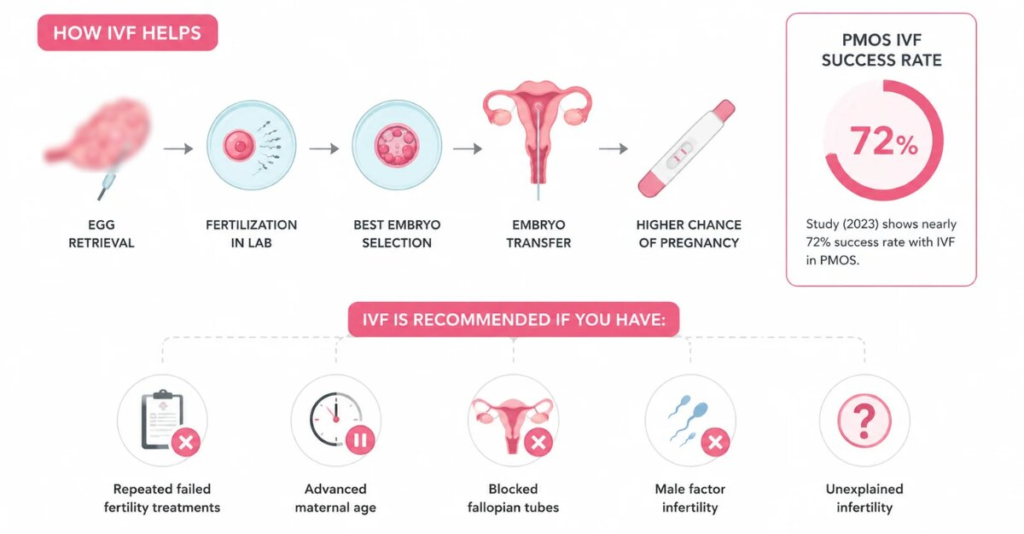
In case ovulation induction and IUI don’t give expected results, IVF can be a more effective option for conceiving a child.
A study conducted in 2023 shows that the PMOS IVF success rate is nearly 72%, showing that many women with PMOS can achieve pregnancy through IVF.
IVF is different from other fertility treatments since it fertilizes the eggs in a laboratory and not in your body. If you’re unfamiliar with the complete process, understanding how IVF treatment works can make each stage easier to follow.
After that, the best embryo is chosen and transferred into your uterus at the right time. The final stage of IVF is the embryo transfer procedure, which plays an important role in achieving pregnancy. This gives you a significantly higher chance of pregnancy, especially when PMOS is impacting other hidden fertility challenges.
We usually recommend considering IVF if you have:
- Repeated failed fertility treatments
- Advanced maternal age
- Blocked fallopian tubes
- Male factor infertility
- Unexplained infertility
Since fertility depends on both partners, a semen analysis report is often one of the first investigations recommended during infertility evaluation.
“One of the biggest advantages of IVF is that we can personalize your treatment based on how your ovaries respond. If needed, we may freeze the embryos and transfer them later, which helps reduce the risk of OHSS and improves treatment safety.”
– Dr Rahul Patel, MS (Obs & Gyn), Gynaecologist & IVF Specialist
Factors That Affect IVF Success in PMOS Patients
The IVF success rate in PMOS women is based on many factors.
These include:
- Age
- Body weight or BMI
- Quality of eggs
- Quality of embryos
- Quality of sperm
- Response of ovaries to fertility medication
- Health condition of your uterus and endometrium
- Other reproductive problems like blocked fallopian tubes or endometriosis
In selected patients, a hysteroscopy procedure or laparoscopic gynecological surgery may be recommended to evaluate the inside of the uterus before fertility treatment.
Final Thoughts: Taking the Next Step Towards Pregnancy

PMOS can make pregnancy more challenging, but effective treatment options are available. At Kalyan Women’s Hospital & IVF Center, in Palanpur, Dr Rahul Patel and the team of expert doctors carefully evaluate your condition and recommend the most suitable fertility treatment and support you at every step.
Whether you need PMOS infertility treatment, ovulation induction in PMOS, or IVF for PMOS, our goal is to provide the right treatment at the right time to give you the best possible chance of pregnancy.
FAQs
No. IVF is not the first treatment for PMOS. Most women begin with lifestyle modification and ovulation induction using medications such as letrozole. IVF is generally recommended only if these treatments fail or when other fertility problems, such as blocked fallopian tubes, male factor infertility, or advanced maternal age, are present.
Not always. Women with PMOS often produce a higher number of eggs, but egg quality can vary from person to person. Factors such as age, insulin resistance, obesity, hormonal imbalance, and overall health may influence egg quality and IVF success.
Yes. Most women with PMOS who conceive through IVF go on to have healthy pregnancies and healthy babies. Regular prenatal care and proper management of conditions such as insulin resistance or gestational diabetes help support a healthy pregnancy.
Yes. PMOS (Polyendocrine Metabolic Ovarian Syndrome) is the updated term proposed by international experts to better reflect the condition’s hormonal and metabolic nature. However, PCOS (Polycystic Ovary Syndrome) is still widely used, and both terms currently refer to the same condition.
Yes. For women who are overweight or obese, even a modest weight loss of 5–10% of body weight may improve hormone balance, restore ovulation, regulate menstrual cycles, and increase the chances of natural conception or fertility treatment success.
IVF may be recommended if pregnancy has not occurred after ovulation induction or IUI, or if additional fertility problems such as blocked fallopian tubes, severe male factor infertility, advanced maternal age, or recurrent treatment failure are present. Early fertility evaluation helps determine the most appropriate treatment plan.

2 Responses