
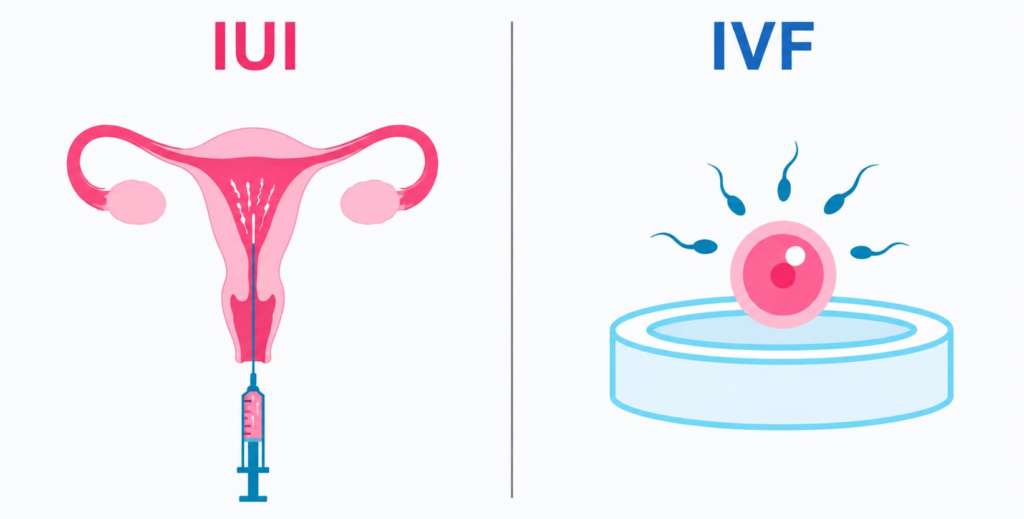
Nowadays, the internet has made fertility-related information more easily available than ever. Reading articles, watching videos, or hearing success stories on social media helps you to learn about fertility treatment, but it can also confuse you.
That confusion is something we see every day in our fertility clinic. Many couples visit us with many questions: “Doctor, should we choose IUI or IVF?” “Is IVF always better than IUI?”
As a fertility specialist, I explain that there is no one perfect fertility treatment that is suitable for every patient. Also, it is important to know that the right approach is not choosing the one that is most popular. It is about choosing the one that matches your fertility needs.
That’s why it is important to understand the difference between IVF and IUI, as it is the first step towards choosing the treatment that’s most suitable for you.
What Is IUI Treatment?
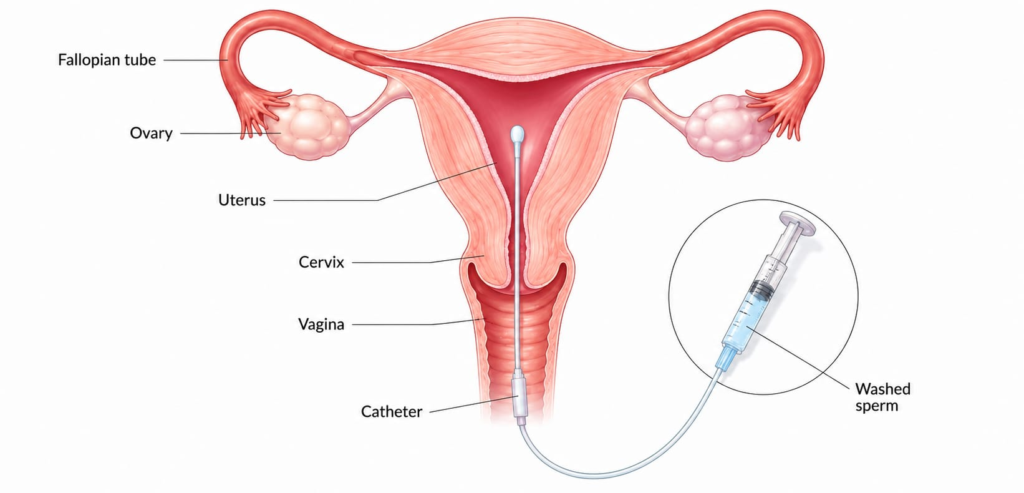
Intrauterine Insemination (IUI), which is one type of assisted reproductive technology (ART), helps your partner’s sperm to reach your egg in an easier way.
IUI stands for:
- Intrauterine: Within the uterus
- Insemination: Insertion of sperm within the uterus
During the IUI cycle, we observe your ovulation and may advise you on fertility medications to help mature your eggs. On the day of the treatment, we collect the semen sample from your partner.
We go through the sperm washing technique and select the healthy sperm. Then, using a thin catheter, we place the sperm inside your uterus. The fertilisation takes place naturally in your fallopian tube.
What Is IVF Treatment?
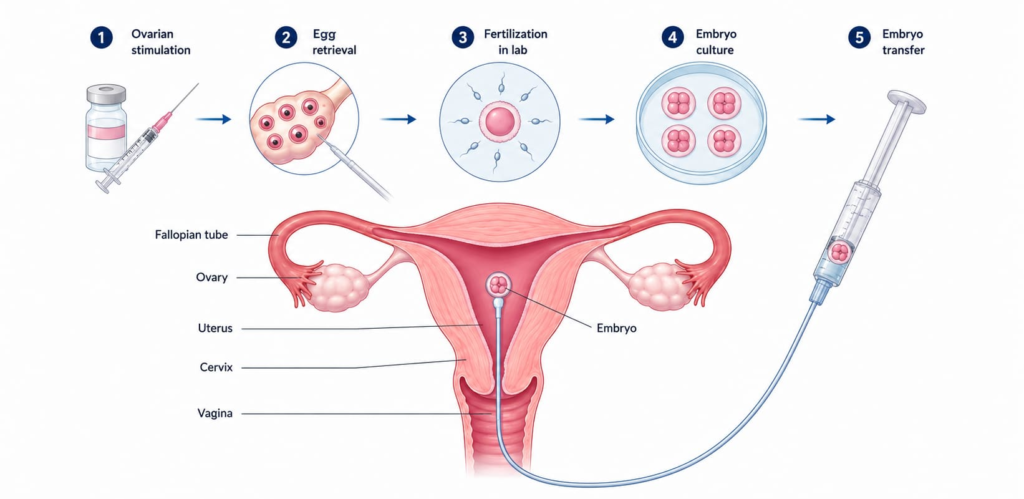
IVF or In Vitro Fertilisation, is also one of the types of ART that help you achieve pregnancy by fertilising your eggs and your partner’s sperm outside the body.
IVF stands for:
- In Vitro: In the laboratory
- Fertilisation: The sperm fertilises the egg to form an embryo
The IVF treatment usually includes:
- Ovarian stimulation: Fertility medications help your eggs mature.
- Egg retrieval: We collect your mature eggs.
- Fertilisation: Your eggs and your partner’s sperm are combined in the laboratory.
- Embryo development: The embryos are monitored as they grow.
- Embryo transfer: A healthy embryo is placed into your uterus.
Now that you know how each treatment works, let’s look at the key differences between IVF and IUI.
IVF vs IUI – Key Differences
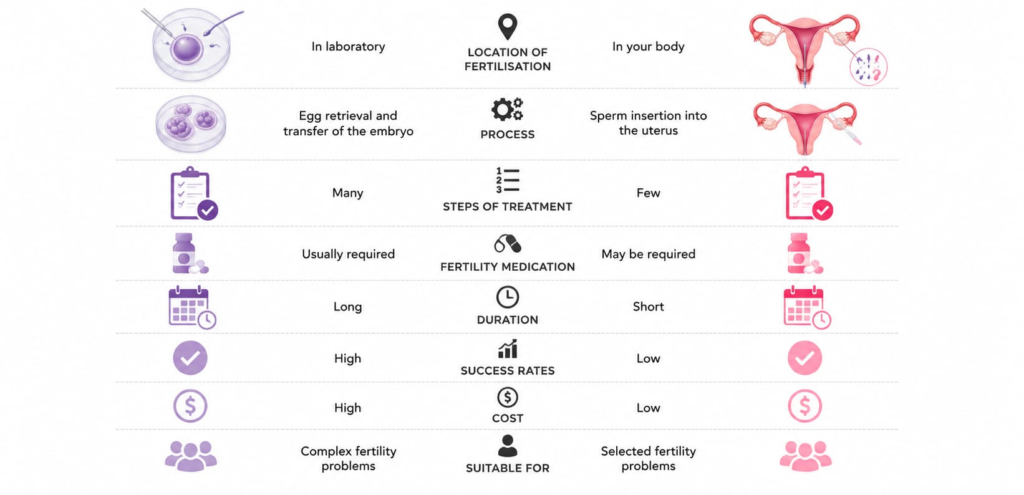
When I discuss with my patients about the possible methods for fertility, I always compare IVF vs IUI in order to help them understand the difference between the two processes and why one is more suitable than the other.
| Features | IVF | IUI |
| Location of fertilisation | In laboratory | In your body |
| Process | Egg retrieval and transfer of the embryo | Sperm insertion into the uterus |
| Steps of treatment | Many | Few |
| Fertility medication | Usually required | May be required |
| Duration of the treatment | Long | Short |
| Success rates | High | Low |
| Cost | High | Low |
| Suitable for | Complex fertility problems | Selected fertility problems |
The next question most patients ask is about their chances of success. Here is what research tells us.
IVF vs IUI Success Rates – Which Is More Effective?
IVF and IUI are two fertility treatments that can be used to get pregnant. However, when comparing IVF vs IUI success rates, IVF has proven to have a higher success rate.
According to a 2025 study published in the Cureus journal, IVF resulted in higher clinical pregnancy rates as compared to IUI.
| Outcome | IVF | IUI |
| Clinical pregnancy rate | 46% | 33.3% |
| Live birth rate | 40% | 23.3% |
Here, clinical pregnancy rate refers to a pregnancy confirmed by a scan, while live birth rate refers to the birth of a baby.
Along with success, cost also matters. So, how much do IVF and IUI cost?
IVF vs IUI Cost Comparison
IUI is generally less costly as compared to IVF. The reason behind it is that IVF involves multiple steps, which include laboratory charges and medicine.
Below is the cost of IUI and IVF in Palanpur:
| Treatment | Approximate Cost |
| IUI | Rs. 5,000-Rs. 15,000 |
| IVF | Rs. 90,000-Rs. 2,00,000 |
These prices can be different in clinics and depend on your individual treatment program. If you’d like a detailed breakdown of treatment expenses, our guide on IVF cost in Gujarat and Palanpur explains the factors that influence the overall cost.
Who Should Choose IUI or IVF?
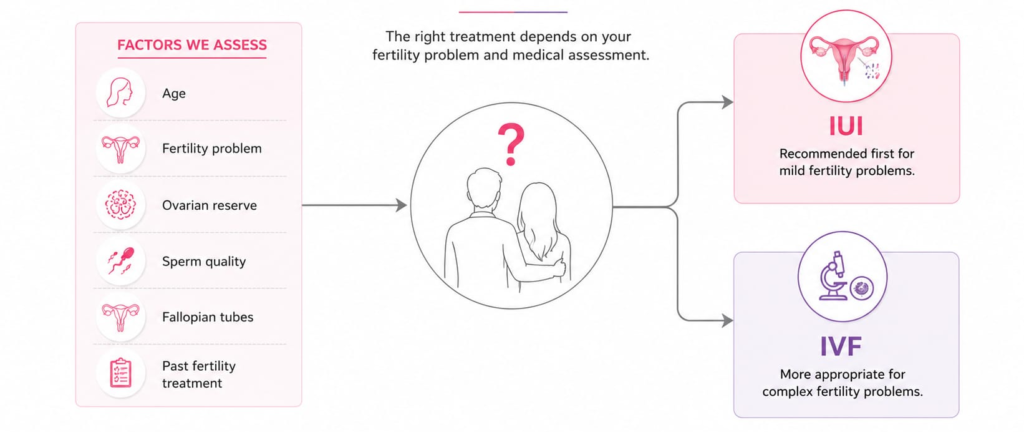
The right treatment depends on your fertility problem and medical assessment. Understanding the underlying cause is equally important, and our article on causes of infertility in women explains the most common conditions that can affect fertility and treatment decisions.
Prior to recommending IUI or IVF, we need to assess the following factors:
- Age
- Fertility problem
- Ovarian reserve
- Sperm quality
- Fallopian tubes
- Past fertility treatment
Based on the above considerations, if you have mild fertility problems, then the IUI procedure would be recommended first. Otherwise, the IVF treatment may be more appropriate for you.
IVF or IUI – Which Is Better for Different Fertility Conditions?
Different fertility conditions respond to IUI and IVF differently.
The table below shows when IUI or IVF may be considered for different fertility conditions.
| Fertility Conditions | When IUI May Be Considered | When IVF May Be Considered |
| IVF vs IUI for PCOS | Mild PCOS with ovulation achieved using fertility medications | Multiple failed IUI cycles, severe ovulation problems |
| IVF vs IUI for Endometriosis | Mild endometriosis with healthy fallopian tubes | Moderate to severe endometriosis |
| IVF vs IUI for Low Sperm Count | Mild male infertility | Moderate to severe low sperm count |
| IVF vs IUI for Blocked Fallopian Tubes | Preferred when one fallopian tube is open | Preferred when both fallopian tubes are blocked |
If male fertility is contributing to conception difficulties, our guide on male infertility causes and treatments explains common causes, diagnosis, and available treatment options.
When Should You Move From IUI to IVF?
Research suggests that successful pregnancies through IUI happen mostly within the first three to four cycles of treatment when your age is under 35 years, and you have no major fertility issues.
In case pregnancy does not take place in these cycles, we suggest trying IVF. We also consider IVF earlier on in case of any problems, such as male infertility or blocked fallopian tubes, or other fertility conditions where IUI is less likely to be successful.
IVF vs IUI After Age 35
Both egg count and quality are reduced as you grow older, making it harder to conceive.
It may be possible for IUI to work when you are 35 years or older, but conception chances are relatively lower. In this case, IVF has a better chance of pregnancy because fertilisation happens in the lab and only the best embryos are transferred into your uterus.
Final Thoughts: Choosing Between IVF and IUI with Confidence

Finding the right fertility treatment can bring clarity and hope during an emotional journey. With the right medical guidance and timely care, you can make an informed decision that supports your parenthood goals.
If you’re planning your first consultation, this guide on your first visit to a fertility clinic explains the tests, questions, and next steps you can expect. At Kalyan Women’s Hospital & IVF Center, Palanpur, Dr Rahul Patel and our dedicated team are here to support you every step of the way.
FAQs
Some couples do conceive during their first IUI cycle, but this is not the case for everyone. Success varies depending on individual fertility factors. In general, younger women with good ovarian reserve, healthy fallopian tubes, and mild infertility have better chances of pregnancy during the first cycle than couples with more complex fertility issues.
IVF generally offers higher success rates because fertilisation takes place in a controlled laboratory environment. Specialists can monitor embryo development, select the healthiest embryo for transfer, and overcome fertility issues such as blocked fallopian tubes or severe male infertility that may reduce the effectiveness of IUI.
No. IVF is not always the first treatment recommended. Many couples with mild infertility may achieve pregnancy through lifestyle changes, ovulation induction, or IUI before considering IVF. The most appropriate treatment depends on your age, fertility diagnosis, ovarian reserve, sperm quality, and previous treatment history.
No. Complete bed rest is generally not required after IUI. Most women can resume light daily activities shortly after the procedure. However, it is advisable to avoid strenuous exercise, heavy lifting, and smoking or alcohol during the two-week waiting period.
Yes, both treatments can slightly increase the likelihood of twins, particularly when fertility medications stimulate the release of multiple eggs. IVF also allows doctors to reduce the risk of multiple pregnancies by transferring a single embryo when appropriate.