

For couples in Sanchore who have been trying to conceive without success, the question is often not simply “Should we consider IVF?” but “When is the right time to see an IVF specialist?”
Infertility can affect either partner, and the right treatment depends on its cause, age, ovarian reserve, sperm health, and previous treatment history. IVF is an important option, but it isn’t the first step for everyone.
Infertility is a common health concern, with the World Health Organisation estimating that around one in six people of reproductive age experience it during their lifetime.
A proper fertility evaluation can help couples understand whether medicines, IUI, IVF, or another approach makes sense for them. For many couples, knowing what happens during your first visit to a fertility clinic can make that initial appointment feel more straightforward.
When Should You Consider IVF Treatment in Sanchore?
Not every couple facing infertility needs IVF straight away. Sometimes medicines, ovulation treatment, lifestyle changes, or IUI may be enough.
But when a specific fertility problem is present, waiting too long can make the journey harder, especially as female fertility changes with age.
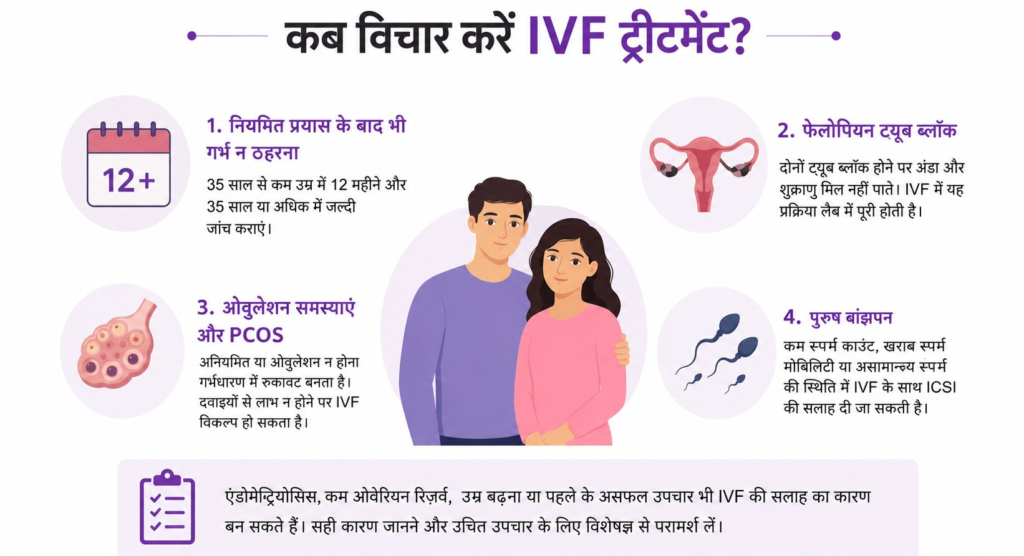
When pregnancy isn’t happening despite regular attempts
For women under 35, infertility evaluation is generally recommended after 12 months of regular unprotected intercourse without pregnancy. For women aged 35 or older, seeking an evaluation sooner is sensible because fertility can decline with age.
Blocked fallopian tubes
If both fallopian tubes are blocked, the egg and sperm may not be able to meet naturally. IVF can help bypass this problem because fertilisation takes place in the laboratory before the embryo is placed in the uterus.
Ovulation problems and PCOS
Irregular or absent ovulation can make conception difficult. PCOS and hormonal problems are common reasons for ovulation issues.
Depending on the situation, a doctor may first recommend medicines or ovulation induction; IVF may be considered when these approaches don’t work, or other fertility factors are involved.
Male infertility
Infertility isn’t only a woman’s concern. Low sperm count, poor sperm movement, or abnormal sperm shape can affect conception. These findings are usually assessed through a semen analysis, so understanding how to read a semen analysis report can also help couples make better sense of the results.
In severe male infertility, IVF with ICSI may be considered, where a selected sperm is injected directly into an egg. Endometriosis, reduced ovarian reserve, age-related fertility changes, or previous unsuccessful fertility treatments can also lead a specialist to consider IVF.
The key point is simple: the reason for infertility matters more than rushing toward a particular treatment. A fertility specialist can assess both partners and suggest the most suitable path.
What Is the IVF Treatment Process?
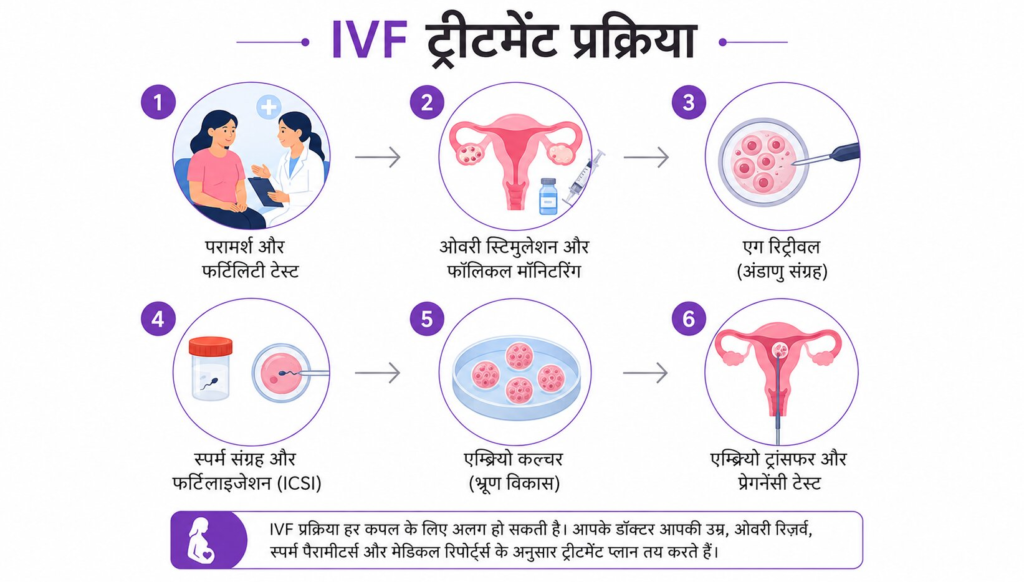
If your doctor recommends IVF, knowing what happens next can make the process feel far less daunting. The IVF process usually follows several stages, although the medicines, timing, and exact protocol can vary from one couple to another.
1. Initial consultation and fertility tests
The process begins with a review of your medical history, previous pregnancies or fertility treatments, and existing reports. The doctor may recommend an ultrasound, AMH and hormonal tests, ovarian reserve assessment, and semen analysis to understand fertility factors on both sides.
2. Ovarian stimulation and follicle monitoring
Fertility medicines may be prescribed to encourage the ovaries to develop multiple eggs. Ultrasound scans and sometimes blood tests help the fertility team monitor follicle growth and decide when the eggs are ready.
3. Egg retrieval
Once the follicles reach the required stage, the eggs are collected through an egg retrieval procedure. The timing is carefully planned as part of the IVF cycle.
4. Sperm collection and fertilisation
A semen sample is collected according to the treatment plan. The eggs and sperm are then brought together in the laboratory for fertilisation. When clinically appropriate, ICSI may be used, where a selected sperm is injected directly into an egg.
5. Embryo culture
After fertilisation, the developing embryos are monitored in the laboratory. The embryology team assesses their development before a suitable embryo is considered for transfer.
6. Embryo transfer and pregnancy testing
A suitable embryo is transferred into the uterus. After the transfer, the doctor advises the couple on when to take a pregnancy test and how to manage follow-up.
So, while an IVF cycle has a clear sequence, it isn’t a one-size-fits-all recipe. Your fertility specialist may adjust the protocol based on your age, ovarian reserve, sperm parameters, previous treatment response, and other medical findings.
IVF vs IUI: Which Treatment May Be Right for You?
If you’re exploring fertility treatment in Sanchore, you may come across two familiar terms: IUI and IVF. But which one is right? There isn’t a universal answer.
| IVF | IUI |
| Egg and sperm are fertilised in a laboratory | Processed sperm is placed inside the uterus |
| An embryo is formed before transfer | Fertilisation happens inside the body |
| May be considered for certain tubal, male-factor, age-related, or other infertility problems | May be suitable for selected couples with less complex fertility issues |
IUI is generally less invasive, while IVF involves ovarian stimulation, egg retrieval, laboratory fertilisation, embryo culture, and embryo transfer.
Here’s the important part: IVF isn’t simply a more advanced version of IUI, and IUI isn’t automatically the better first choice. Your age, ovarian reserve, sperm parameters, infertility cause, and response to previous treatment all matter. A fertility specialist can use these findings to decide whether IUI, IVF, or another approach is more appropriate.
What Affects IVF Success Rate?
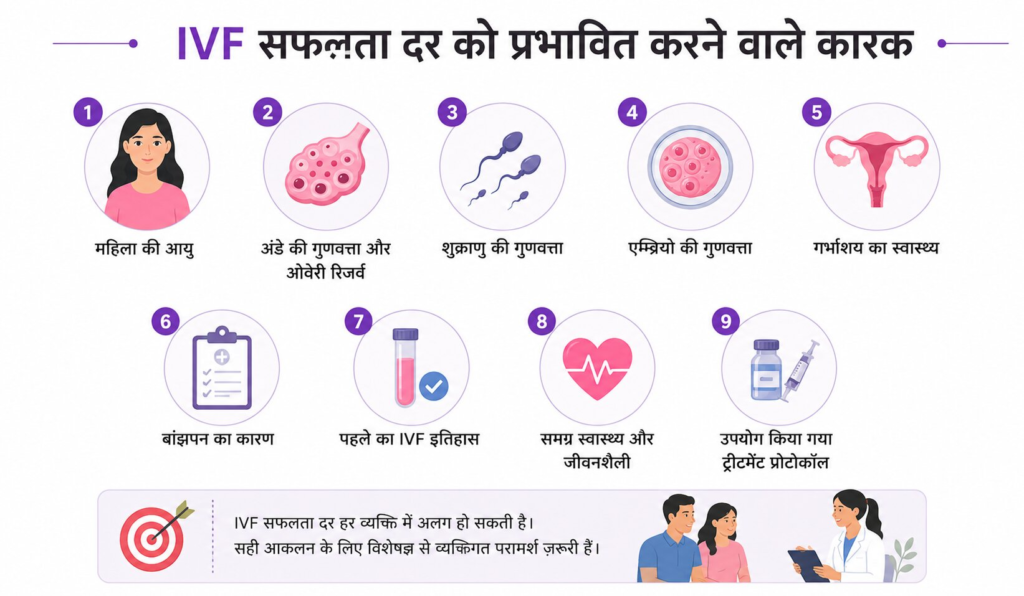
One of the first questions couples ask before starting IVF is, understandably, “What are my chances of success?” There isn’t one percentage that applies to everyone. IVF outcomes can vary widely, and age is one of the important factors.
According to the source material, the main factors that can affect IVF success include:
- Female age
- Egg quality and ovarian reserve
- Sperm quality
- Embryo quality
- Uterine health
- Cause of infertility
- Previous IVF history
- Overall health and lifestyle
- The treatment protocol used
Age deserves particular attention because egg number and quality tend to decline over time. That doesn’t mean IVF cannot work at an older age; it means the fertility specialist needs to assess the individual’s situation carefully.
So, when comparing IVF success rates, don’t look at a single headline number and assume it predicts your outcome. Ask what patient group the figure represents, what outcome is being measured, and how factors such as age and embryo quality are considered. A personalised assessment gives a much more meaningful picture than a generic percentage.
How Much Does IVF Treatment Cost?
For couples researching IVF cost in Sanchore, the final amount can vary because an IVF cycle isn’t the same for every patient. The treatment plan, medicines, investigations, and any additional procedures can all affect the total.
Common cost components may include:
- Initial consultation and fertility tests
- Fertility medicines and ovarian stimulation
- Egg retrieval
- IVF laboratory and embryology charges
- Embryo culture and transfer
- ICSI, when clinically appropriate
- Embryo freezing, if required
Rather than choosing a clinic based only on a quoted package price, ask what the package actually covers and which services may be charged separately. A clear treatment estimate can help you plan financially and avoid unpleasant surprises later.
It can also be worth checking whether health insurance covers any part of IVF or related gynaecological treatment before finalising your financial plan.
How to Choose an IVF Centre Near Sanchore
Choosing an IVF centre is about more than finding the nearest clinic. If you’re travelling from Sanchore for fertility treatment, you may need several appointments, monitoring visits, and clear communication along the way. So, what should you actually look for?
Start with an experienced IVF specialist who takes time to understand both partners rather than treating infertility as a one-sided problem. Ask whether the centre provides fertility testing, IVF, embryology services, and techniques such as ICSI when medically appropriate. Transparent discussion about treatment plans and IVF package cost also matters; you should know what is included and what may cost extra.
Good counselling and follow-up are equally important. IVF can be physically demanding and emotionally tiring, so having a team that explains each step clearly can make the journey easier. For couples from Sanchore, access to a specialist through a local consultation camp can also be useful before travelling for treatment.
Free IVF Camp in Sanchore: A Convenient First Step for Couples
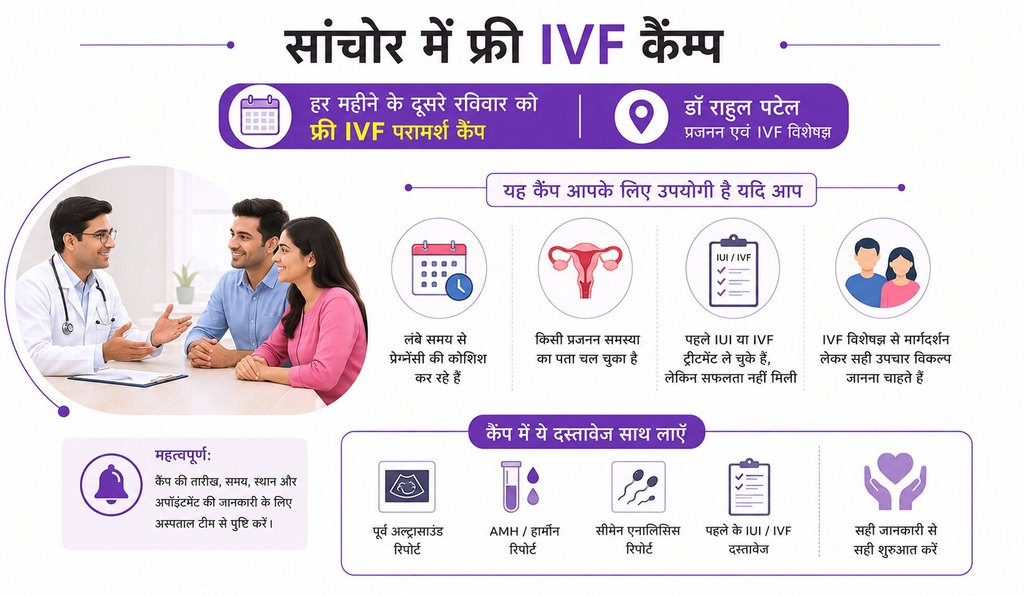
For couples in Sanchore who aren’t sure where to begin, a local fertility consultation can remove one big hurdle: the need to travel before you even know what treatment you may need. Dr Rahul Patel conducts a Free IVF Camp in Sanchore on the second Sunday of every month, giving couples an opportunity to discuss fertility concerns and understand their treatment options.
The camp may be useful if you’ve been trying to conceive for a long time, have an identified fertility problem, or have already undergone IUI or IVF without success. It’s also a practical starting point if you’re searching for an IVF specialist near Sanchore.
If you’re attending, carry relevant records such as previous ultrasound scans, AMH or hormone reports, semen analysis, and previous IUI or IVF documents. The exact camp date, timing, venue, and appointment availability should be confirmed with the hospital team before visiting. That small step can save you an unnecessary trip and help the consultation run more smoothly.
IVF Treatment Near Sanchore at Kalyan Women’s Hospital & IVF Center
For couples looking for IVF treatment near Sanchore, IVF treatment in Palanpur may be one option to consider when specialist fertility care is needed beyond the initial consultation. The centre provides fertility evaluation, IVF treatment, embryology services, and advanced techniques such as ICSI when clinically appropriate.
Dr Rahul Patel, Gynecologist and IVF Specialist, has more than 10 years of clinical experience and has reported experience with 2,000+ IVF cycles, 3,600+ laparoscopic gynaecological surgeries, and 6,400+ deliveries.
For families travelling from Sanchore, the monthly camp can be a practical starting point. If further treatment is recommended, the couple can then discuss the next steps, expected costs, investigations, and treatment plan with the fertility team at the Palanpur centre.
What Should You Do After an IVF Consultation?
A fertility consultation isn’t necessarily the moment when you decide, “We’re doing IVF.” In many cases, it’s the point where the picture finally becomes clearer.
Your doctor may review your medical history, ultrasound findings, AMH or other fertility tests, and your partner’s semen analysis before suggesting what comes next. Depending on the findings, that could mean trying medication or IUI, treating an underlying condition, or planning an IVF cycle.
If IVF is recommended, don’t hesitate to ask practical questions: Why is IVF suitable in our case? What tests are still needed? What will the treatment involve? Which costs are included? These answers can help you make a more informed decision rather than feeling pressured to rush.
For couples travelling from Sanchore, starting with the Free IVF Camp in Sanchore can be a convenient way to discuss their fertility concerns with Dr Rahul Patel. If further treatment is advised, the fertility team can explain the next steps at Kalyan Women’s Hospital & IVF Center in Palanpur.
Taking the Next Step Toward Fertility Care

For couples in Sanchore, the first step doesn’t have to be deciding on IVF. It starts with understanding why pregnancy hasn’t happened and which treatment fits your situation. A fertility evaluation can help guide that decision, whether the answer is IUI, IVF, or another approach.
If you’re looking for IVF treatment in Sanchore, the monthly Free IVF Camp by Dr Rahul Patel offers a local opportunity to discuss your concerns before planning further care. When IVF is recommended, Kalyan Women’s Hospital & IVF Center in Palanpur provides fertility and IVF services with personalised treatment planning. The right treatment isn’t about rushing—it’s about getting the right guidance at the right time.
FAQs
IVF may be considered for couples facing blocked fallopian tubes, severe male infertility, certain ovulation problems, endometriosis, reduced ovarian reserve, or unsuccessful previous fertility treatments. However, IVF is not automatically the first treatment for every couple. Depending on the cause of infertility, medicines or IUI may be considered first.
In IUI, processed sperm is placed inside the uterus, and fertilisation takes place inside the body. In IVF, eggs and sperm are fertilised in a laboratory, and a suitable embryo is later transferred to the uterus. The right treatment depends on factors such as age, infertility cause, ovarian reserve, and sperm parameters.
The total IVF cost can vary depending on the treatment plan, fertility medicines, investigations, egg retrieval, laboratory procedures, embryo transfer, ICSI, or embryo freezing if required. Before starting treatment, it is sensible to ask exactly what is included in the quoted package and which services may involve additional charges.
Yes. A consultation can help couples understand the possible reason pregnancy has not happened before making a treatment decision. The doctor may review previous ultrasound scans, AMH or hormone reports, semen analysis, and earlier IUI or IVF records before suggesting the next step.
Carry any relevant medical records, including previous ultrasound scans, AMH or hormone reports, semen analysis results, and documents from earlier IUI or IVF treatment. Having these reports available can help the fertility specialist understand your history more clearly.
The number of visits varies depending on the treatment protocol and individual response. IVF usually involves consultations, monitoring appointments, egg retrieval, and embryo transfer, among other visits. Couples travelling from Sanchore should ask about the expected visit schedule before treatment begins.