

The day you find out you are pregnant, your routine can suddenly feel very different. The same stairs you climbed yesterday, the same cup of tea you enjoyed, or a little cramp you would normally ignore may now make you pause and think, “Could this affect my baby?”
These worries are very natural. We often see women become overly careful because they believe that one wrong step can cause a miscarriage. But this is not always true.
So, what is a miscarriage?
A miscarriage is the spontaneous loss of a pregnancy before 20 weeks. About 1 in 5 pregnancies end in miscarriage during the first three months after a positive pregnancy test, and that is not in your control.
How can you avoid it?
My approach is simple: understand what you can control, take precautions and know when something needs medical attention.
Let’s look at the precautions during early pregnancy to avoid miscarriage.
Signs & Symptoms of Miscarriage in Early Pregnancy
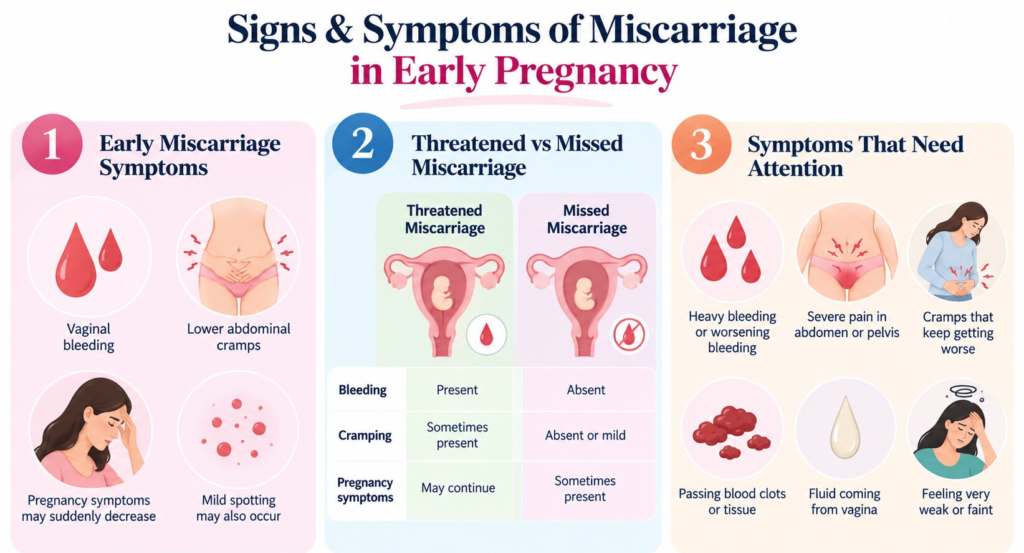
Here, we explain the signs and symptoms of early pregnancy so you can understand when your signs indicate you need to see your fertility specialist. Also, we discuss threatened and missed miscarriage.
1. Early Miscarriage Symptoms
Vaginal bleeding is the first and most common sign of early miscarriage that causes concern during the first trimester. It may occur with lower abdominal cramps. Also, some women may experience pregnancy symptoms that suddenly become much less noticeable
The signs may differ in every woman. Some may have mild symptoms, and some have no symptoms at all. Also, mild spotting or cramping does not always mean miscarriage.
2. Missed & Threatened Miscarriage
Sometimes, early pregnancy symptoms can be confusing, and two women with a similar concern may have very different findings.
Miscarriage can present in different ways:
- Threatened miscarriage: A threatened miscarriage means there is bleeding in early pregnancy, but the pregnancy may still be developing normally.
- Missed miscarriage: The pregnancy is no longer developing, but your body has not passed the tissue yet.
The following is a table comparing the two conditions:
| Feature | Threatened Miscarriage | Missed Miscarriage |
| Bleeding | Present | Absent |
| Cramping | Sometimes present | Absent or present but mild |
| Pregnancy symptoms | May continue | Sometimes present for some period of time |
3. Symptoms That Need Attention
Some signs you should not ignore; consult your doctor if :
- You have heavy bleeding, or it is getting worse
- You feel severe pain in your abdomen or pelvis
- Your cramps keep getting worse
- You pass blood clots or tissue from your vagina
- You notice fluid coming from your vagina
- You feel very weak, or faint
Causes of Miscarriage in Early Pregnancy
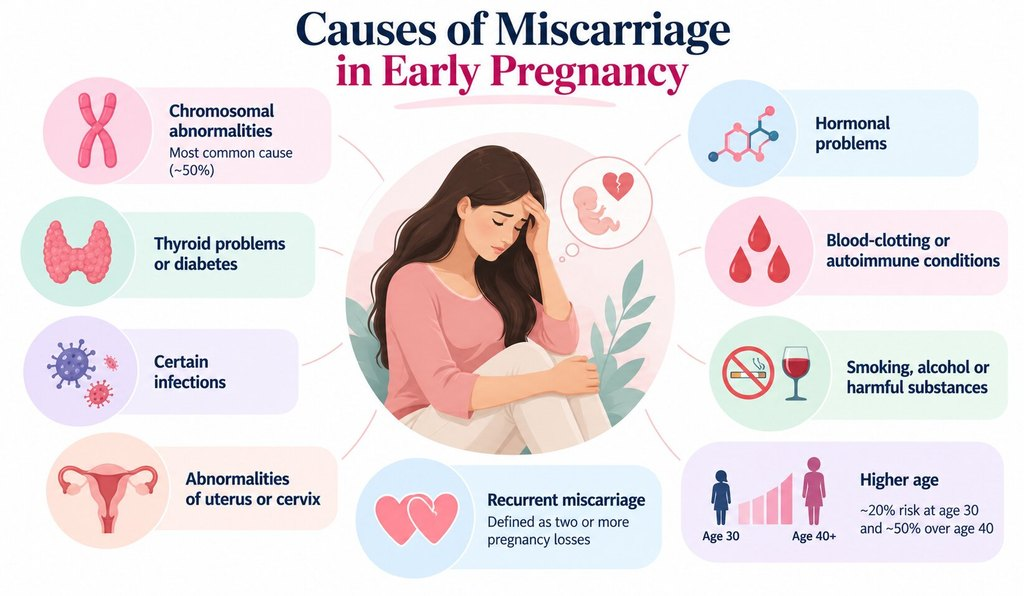
As per a 2018 study reviewing 1,000 first-trimester miscarriages, chromosomal abnormalities were found in around 50% of the developing embryos. This usually happens by chance and is not caused by exercise, routine work or something the mother ate.
Other factors that may increase the risk include:
- Thyroid problems or poorly controlled diabetes
- Certain infections
- Abnormalities of your uterus or cervix
- Hormonal problems
- Some blood-clotting or autoimmune conditions
- Smoking, alcohol or certain harmful substances
- The risk of miscarriage is around 20% at age 30 and around 50% over age 40
When a uterine abnormality needs further evaluation, your doctor may consider tests or procedures such as hysteroscopy depending on your symptoms and medical history.
It is important to remember that having a risk factor does not mean that a miscarriage will definitely happen.
Conditions such as PCOS/PCOD can affect reproductive health and may require evaluation as part of fertility or pregnancy planning.
But sometimes experiencing more than one pregnancy loss can be emotionally difficult and may require a closer look at possible causes, and it may link to recurrent miscarriage.
Some pregnancy losses may also be associated with underlying fertility-related factors, so understanding the causes of infertility in women can be helpful when pregnancy does not occur or losses happen repeatedly.
As per ASRM, It is generally defined as two or more pregnancy losses. It affects 1 to 2 out of 100 women.
Depending on your history, we may suggest further evaluation to understand the reason for the repeated losses. Our aim is to identify any treatable problem and plan appropriate care before or during the next pregnancy.
Precautions During Early Pregnancy to Avoid Miscarriage
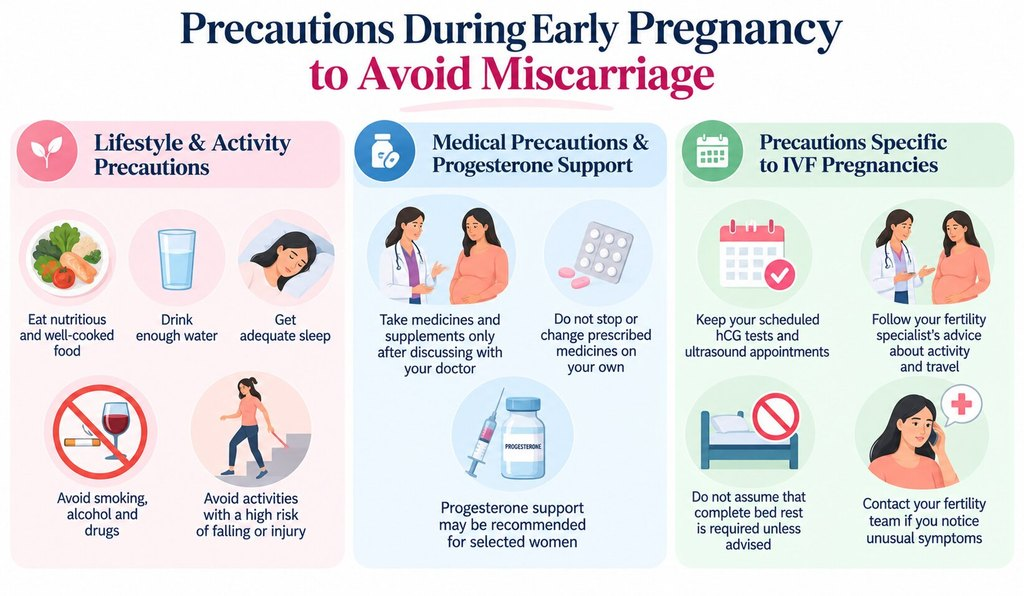
Once pregnancy is confirmed, the aim is not to stop every normal activity but to take sensible steps that support your health and pregnancy.
For women who have conceived through treatment, understanding the stages involved in IVF treatment in Palanpur can also help put post-treatment pregnancy care into context.
Many miscarriages cannot be prevented, but good daily habits, appropriate medical care and timely monitoring can help reduce avoidable risks.
| Lifestyle & Activity Precautions | Eat fresh, nutritious and well-cooked food |
| Drink enough water and get adequate sleep | |
| Avoid smoking, alcohol and recreational drugs | |
| Avoid activities with a high risk of falling or injury | |
| Medical Precautions & Progesterone Support | Take medicines and supplements only after discussing them with your doctor |
| Do not stop or change prescribed medicines on your own | |
| Progesterone support may be recommended for selected women, depending on their individual situation | |
| Precautions Specific to IVF Pregnancies | Keep your scheduled hCG tests and ultrasound appointments |
| Follow your fertility specialist’s advice about activity and travel | |
| Do not assume that complete bed rest is required unless specifically advised | |
| Contact your fertility team if you notice unusual symptoms |
Women who have recently undergone treatment may also find it useful to understand the precautions after embryo transfer in IVF during the early days of pregnancy.
After an embryo transfer, following the prescribed medicines and attending scheduled follow-up appointments are important parts of early pregnancy care.
Treatment If Miscarriage Occurs
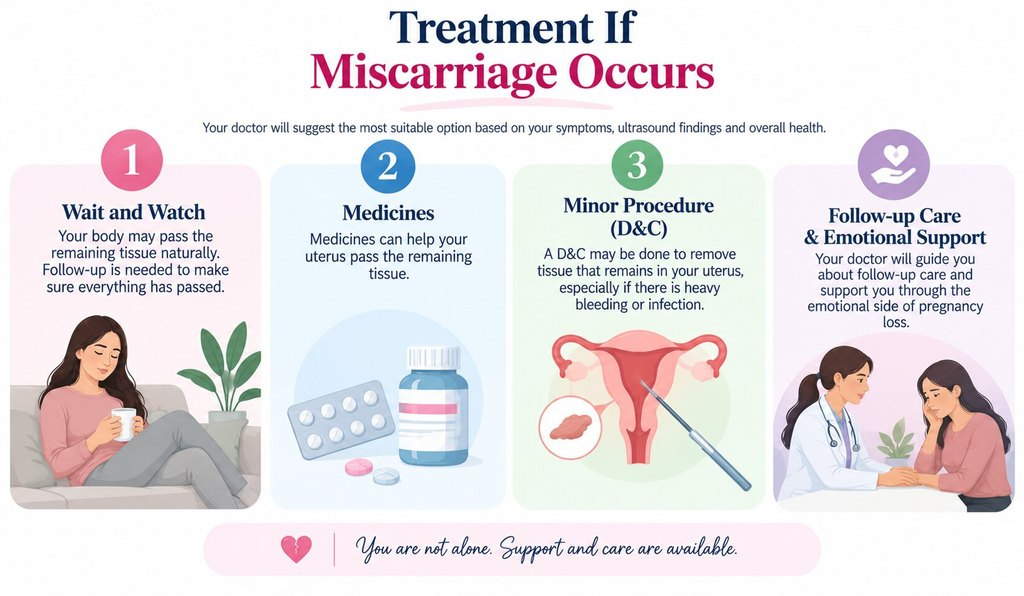
If a miscarriage is confirmed, treatment depends on your symptoms, ultrasound findings, pregnancy stage and whether any pregnancy tissue remains in the uterus.
Your doctor may discuss the safest option for you.
Treatment may include:
- Wait and watch: Your body may pass the remaining tissue naturally. You may need follow-up to make sure everything has passed.
- Medicines: Medicines can help your uterus pass the remaining tissue.
- Minor procedure: A D&C may be done to remove tissue that remains in your uterus, especially if there is heavy bleeding or infection.
We may also guide you about follow-up care and help you through the emotional side of pregnancy loss.
When to Contact Your Doctor
You do not need to wait for a serious problem before speaking with your doctor. If something feels different from your usual pregnancy experience, or you are simply unsure about a medication, activity, or symptom, reach out for advice. Women with previous pregnancy losses or an IVF pregnancy may also need a more personalised follow-up plan during the early weeks.
Why Choose Kalyan Women’s Hospital & IVF Center to Avoid Miscarriage

At Kalyan Women’s Hospital & IVF Center, Palanpur, Dr Rahul Patel focuses on providing personalised care during early pregnancy. From regular pregnancy monitoring and ultrasound assessment to managing concerns based on your individual history, the aim is to identify potential risks early and provide timely guidance. Whether your pregnancy is natural or through IVF, you receive care planned around your specific needs.
Conclusion
You cannot prevent every miscarriage, and it is not your fault when one happens. Focus on what you can control: eat well, follow your doctor’s advice, take your prescribed medicines and attend your check-ups. These simple steps can help you feel more confident during early pregnancy.
FAQs
The risk of miscarriage is generally highest during the early weeks of pregnancy and decreases as the pregnancy progresses. The first trimester is the period when most miscarriages occur. Individual risk varies according to factors such as maternal age, pregnancy history, and underlying health conditions, so a specific week cannot be considered universally the riskiest for every pregnancy.
Folic acid does not guarantee that a miscarriage can be prevented, because many early miscarriages result from chromosomal abnormalities. However, folic acid is important before and during early pregnancy because it supports healthy fetal development and helps prevent neural tube defects. The appropriate dose should be discussed with a healthcare professional, particularly if a higher dose has been recommended.
The risk of miscarriage generally decreases as pregnancy progresses, particularly after the first trimester. The risk also decreases after normal developmental findings are confirmed on ultrasound. However, there is no specific point at which miscarriage becomes impossible, so continuing routine prenatal care is important.
An embryo may stop developing for several reasons, with chromosomal abnormalities being an important cause of early pregnancy loss. Other possible factors include hormonal problems, uterine abnormalities, infections, and certain maternal health conditions. A doctor may recommend an ultrasound and other investigations depending on the circumstances.
Alcohol should be avoided during pregnancy. Caffeine intake should also be kept within the amount recommended by your healthcare professional. Avoiding recreational drugs and choosing safe, nutritious drinks can support overall pregnancy health.
The active phase of a miscarriage can take several hours to a few days, while bleeding or spotting may continue for longer. The duration varies depending on the pregnancy stage and how the miscarriage is managed. If bleeding is very heavy or accompanied by severe pain, dizziness, fainting, or fever, urgent medical attention is needed.